Gas By Another Name — Cont.

Filed Under Cloud gazing, Environment, Weather | Leave a Comment

Another under-reckoning.
From Nature:

Recent studies have focused on the short-term contribution of the Greenland ice sheet to sea-level rise, yet little is known about its long-term stability.

Here, using a fully coupled model, we show that this criterion systematically overestimates the temperature threshold and that the Greenland ice sheet is more sensitive to long-term climate change than previously thought.

And the backlash commonly cited by this process is the rise of sea levels — the rub, though, is that nasty-ass methane bubbling up into the environment with the melting.

May’s March Madness

Filed Under Cloud gazing, Environment, Weather | Leave a Comment

Flowers blooming early — spring ain’t til next Tuesday:

“My nightmare now is this weather,” Japanese ambassador to the U.S. Ichiro Fujisaki said at press briefing today at the National Press Building.
“What are we going to do if all the cherry blossoms bloom before we start [the annual National Cherry Blossom Festival]?,” he said.
“That’s my nightmare.”

Well, as the rocker springs to the mocker: Welcome to everybody’s nightmare.

In the warmest winter maybe since 1872, spring has come way-early this year and in the US it’s heat in the east, snow in the west — creating a weather paradox that allows a glimpse into a future of extremes from flooding to drought.

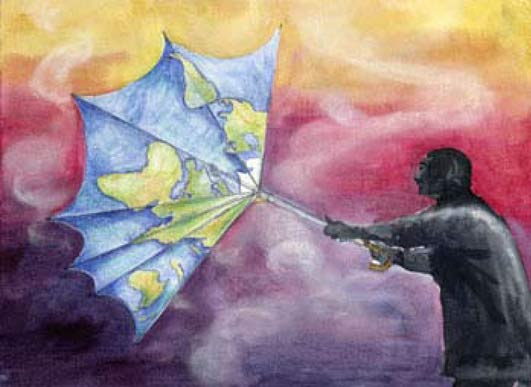
(Illustration found here).

In the last few weeks, reportedly all kinds of record temperatures were recorded in the US and although several reasons are factored into the events, the punch to the heat comes from climate change — as was/is called,”weather on steroids.”
From Climate Central:

On March 13 alone, 184 record high temperatures were broken or tied across the country, according to the National Oceanic and Atmospheric Administration (NOAA).
Between March 6-12, 1,146 warm temperature records (record daily highs and record warm daily lows) were set or tied, compared to just 277 cold temperature records.
In a long-term trend that has been linked to global climate change, daily record-high temperatures have recently been outpacing daily record-lows by an average of 2-to-1, and this imbalance is expected to grow as the climate continues to warm.
According to a 2009 study, if the climate were not warming, this ratio would be expected to be even.

Despite even cooling temperatures in Australia, for an instance of an oddity, a new report shows that the climate is starting to bake real good.
And it’s not going to be pretty: There were further uncertainties relating to tipping points in the climate system, such as the break-up of ice sheets, which could lead to rapid climate change, the report says. “Unless greenhouse gas emissions decrease, we expect to see the temperature of the atmosphere and the oceans continue to warm and sea levels continue to rise at current or even higher rates,” the report says.
Australia’s second State of the Climate report also says the concentration of CO2 in the atmosphere last year was 390 parts per million, higher than at any time for the past 800,000 years.
I haven’t any kind of a clue how these guys figure that shit out, but it don’t look real fun.

In another similar post this morning at Skeptical Science, a lot of numbers and equations and charts are boiled down into language even an idiot like me could understand.
One illustration is how Australia’s Sydney Harbour could be emptied twice a day if all the heat accumulating the earth’s oceans were turned onto one spot — these brainiacs says it’s equal to two Hiroshima bombs going off every second, and this since 1961.
A couple of snips:

But why don’t we notice this?
Because instead of all this heating happening just in Sydney Harbour, this is spread out through out the worlds oceans.
And they are huge: 2,300,000 times the size of Sydney Harbour.
So heat that boils the harbour would only warm the entire ocean by a fraction of a degree.
So we don’t notice it much.
Not that it isn’t real, just that we don’t notice it.
And if this much heat had instead gone into just warming the atmosphere — you know, that thing we call Climate — it would have raised Air temperatures by around 42 °C over the last 1/2 Century!
When I was in kindergarten, in 1961, a hot day at the beach was 35 °C.
Imagine that it was now 77 °C.

When the first analyses of Ocean Heat Content calculated from old temperature data from the oceans where first published in the early 2000′s, they were described as the ‘Smoking Gun’.
Because they were.
They are the primary observational evidence for Global Warming and the human nature of it.

A rose by any other name is a cherry blossom.

Twisters on Time

Filed Under Cloud gazing, Environment, Politics, Weather | Leave a Comment

In terms of pure weather horror, this past week should send a complete, focused message to peoples everywhere — the climate is quickly shifting and all bets are off.

Ohio Gov. John Kasich on tornadoes: “It’s like a bomb went off and everything is splintered, bricks are down and trees, and (there’s) just a lot of debris.”
And then Kasich on federal funds for help in the mess: “I believe that we can handle this,” Kasich said while visiting a shelter for storm victims at New Richmond High School. “We’ll have down here all the assets of the state.”
Fairly-obvious response: “I question his judgment. It would appear at first blush that he’s probably playing politics.” (local Democratic Party honcho, Dave Lane).

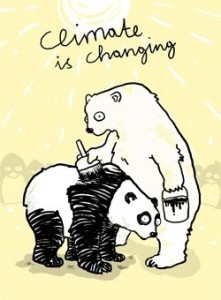
(Illustration found here).

Eventually, Kasich will do more than blush — like all assholes, he will have to walk back a lot of dumb-ass shit.
He’s a Tea Party dip-wad with an apparent disregard for the folks who live in Ohio, thus has a dangerous mind when it comes to governing — pity the poor folks having to handle both horrible weather and a jerk of a governor.

And although global warming is the noted culprit in making these whacked-out storms even more fierce, the folks at Climate Central explain the phenomenon the old-fashioned way — temperatures.
From a post this morning:

Luckily, we have more information than just the models (don’t get me wrong, we love climate models here at Climate Central; they just have their limits, like anything else with a million zillion moving parts).
We have the observational record!
Which is weather-weenie speak for a whole bunch of thermometers telling us how hot and cold it was, every day, at thousands of locations across the country for the past 120 years or so.
Thermometers are good because they tend to be non-partisan, which is extra important when it comes to climate change.
There are no ruthless, ice-cold Santorum thermometers, no warm and fuzzy Obama thermometers and no wishy-washy Romney thermometers that change temperature depending on who is collecting the data.
Nope.
Just thermometers.
Thousands of ‘em doing the same job, day in and day out, 365 days a year, for more than a 100 years.
So to see what’s going on this winter and whether it means anything, we have collected the thermometer data and looked at it for 11 U.S. cities.
The results confirm what most people sense: winters are getting warmer as a result of an overall warming trend caused by air pollution with carbon dioxide, methane, fluorocarbon refrigerants and other greenhouse gasses.
(OK. I’m not sure most people “sense” that last half of that sentence, but they should).

They then go through the data — pretty convincing.

Climate change is the big bugger in the nose of humanity.
And the problem is that these twister examples last week will only get worse and will get worse faster than people realize, even the experts.

Joe Romm, who runs the most-excellent Climate Progress, had a post up last week — a Leap Day Special he called it — about the mistakes he’s made during the course of his career (a Ph.D. in physics from MIT., and a former acting US assistant secretary of energy for energy efficiency and renewable energy in 1997), which included a glimpse into the real terror of climate change.
Romm says of his biggest mistake:

I have consistently underestimated the timing and speed of climate impacts and the level of greenhouse gas emissions that would likely cause catastrophic warming.
In the 1990s, I was mostly a 3°C or 550 ppm guy.
In fact, looking at my 2004 book, The Hype About Hydrogen, I now see that it actually floated a scenario in which “in 2037, the the National Academy of Sciences’ Panel on Abrupt Climate Change, noting that the 3 previous years were a full 1°F warmer than the past decade, urges CO2 stabilization at 650 ppmv within 50 years.”
Ouch.

So all this increasingly freakish weather is coming at us faster that anyone really knows — we’re really in a blind on time.

An Ocean of Weather

Filed Under Cloud gazing, Environment, Weather | Leave a Comment

After growing up in the tornado-infested deep South, ugly weather has always scared-the-living-shit out of me — my dad’s mother always pitched a wailing fit when the wind started howling, crying about how we’re all gonna die.
After time, this display of anti-bravado made a big impression on a naive little kid trying to grow up.

Nowadays, this problem is way out of whack.

A grown daughter lives in a small town south of Nashville, Tennessee, and this morning I ache for the whole region — after the horror on Wednesday, there’s more bad weather with them asshole twisters set again for today.

Shit-on-a-global-warmed-stick.

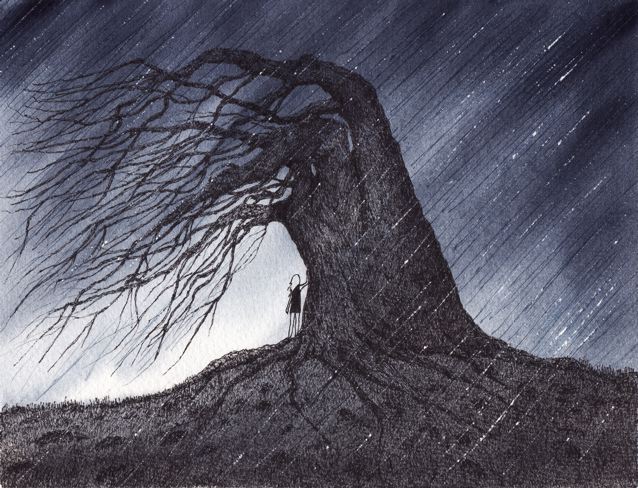
(Illustration of Pablo Picasso’s Bathers found here).

When I talked to my daughter last Wednesday evening she’d told me the weather was then near-gorgeous — sunny and warm, though there had been some bad, dark clouds earlier — and her only problem was she’d tripped while jogging, skinning her knee.
I almost wanted to cry.
Now I gotta sweat through today.

In the wake of this week’s weather chaos — 33 confirmed tornadoes killing 13 people — there’s more to come, with a potential of being even worse.
Early this morning from ABC News:

The National Weather Service has indicated a moderate risk of severe thunderstorms for the Ohio and Tennessee Valleys.
These storms are be capable of producing winds of 75 miles per hour, large hail and long-lived significant tornadoes, according to the NWS.
“That area centered on Tennessee and especially Kentucky looks like it has the potential for some rather long track, what we call super cell storms or tornadoes along and ahead of a cold front,” Thompson said (Rich Thompson, lead forecaster with the National Storm Prediction Center in Norman, Okla.)
“And if that actually occurs this would be the type of scenario where we could have some fairly strong longtrack tornadoes,” he added.
“Today actually has the potential to cause even more problems than just two days ago.”

All this crunching weather is just normal for a planet going to bad-shit quick.
In the last couple of years, the concept of “extreme weather events” has become near-part-n-parcel for a warmed-up climate, which brings about 4 percent more water into the atmosphere and thusly more crazed the environment.
This from USATODAY last September:

In 1950, U.S. record breaking hot weather days were as likely as cold ones.
By 2000, they were twice as likely, and in 2011 they are three times more likely, so far.
By the end of the century they will be 50 times more likely, Meehl says (Jerry Meehl of the National Center for Atmospheric Research).

“There’s really no such thing as natural weather anymore,” says climate scientist Donald Wuebbles of the University of Illinois, who was not involved with the report, but said he largely agreed with its conclusions.
“Anything that takes place today in the weather system has been affected by the changes we’ve made to the climate system.
That’s just the background situation and it’s good for people to know that,” Wuebbles says.
Although scientists cannot immediately tie what percentage of an extreme weather event relies on global warming to make it more severe, he says.
“It’s always a factor in today’s world.”

And from from Dr. Jeff Masters yesterday on Wednesday’s twister outbreak:

Violent February tornadoes are rare in February.
The Tornado History Project lists eighteen EF-4 and one EF-5 tornadoes in the U.S. during the month of February since 1950 — an average of one violent February tornado every three years.
Part of the reason for this is the lack of warm, unstable air so early in the year.
However, this year’s unusually mild winter has led to ocean temperatures across the Gulf of Mexico that are approximately 1°C above average — among the top ten warmest values on record, going back to the 1800s.
Averaged over the month of February, the highest sea surface temperatures on record in the Gulf between 20 – 30°N, 85 – 95°W occurred in 2002, when the waters were 1.34°C above average.
Yesterday’s tornado outbreak was fueled, in part, by high instability created by unusually warm, moist air flowing north from the Gulf of Mexico due to the high water temperatures there.

And those oceans are in a mess right now, as with the warming, the make-up of the water is getting deadly.
Oceans are turning into near-battery acid.
New research indicates the oceans are becoming more acidic at a much faster rate than previously figured.
Via Raw Story:

High levels of pollution may be turning the planet’s oceans acidic at a faster rate than at any time in the past 300 million years, with unknown consequences for future sea life, researchers said Thursday.

They found only one time in history that came close to what scientists are seeing today in terms of ocean life die-off — a mysterious period known as the Paleocene-Eocene Thermal Maximum about 56 million years ago.
Though the reason for the carbon upsurge back then remains a source of debate, scientists believe that the doubling of harmful emissions drove up global temperatures by about six degrees Celsius and caused big losses of ocean life.

“We know that life during past ocean acidification events was not wiped out — new species evolved to replace those that died off,” said lead author Barbel Honisch, a paleoceanographer at Columbia University’s Lamont-Doherty Earth Observatory.
“But if industrial carbon emissions continue at the current pace, we may lose organisms we care about — coral reefs, oysters, salmon.”
Honish and colleagues said the current rate of ocean acidification is at least 10 times faster than it was 56 million years ago.

This ain’t the stone age, or whatever — I don’t have a clue how these guys can figure out what happened 56 million years ago, or even how they can determine the amount of carbon that was in the air in 1750.
The science of climate change is beyond my brain level — but the weather is something else, that I can see out my window.
And makes me a humongous worry-wart for my children.

Tea Cup Turbulence

Filed Under Cloud gazing, Environment, Finance, Weather | Leave a Comment

Climate change is corrupting Bangladesh tea — the low-lying nation has a great tea growing industry, but the warming temperatures with less rain not only stumps growth, but can alter the flavor.
From Aljazeera English and a tea harvester:

“There is less clouds in the sky than before. Too much sun, which isn’t good for the plants, a lot less rain. How do you expect the plants to grow?”

Hundreds of thousands of people depend on the tea sector, but if climate change is responsible for the hotter weather being experienced now, it is just a matter of time before these plantations perhaps disappear altogether.

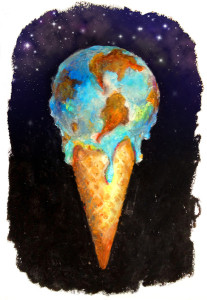
(Illustration found here).

Although Bangladesh tea picture is rosy right now — The average price of Bangladeshi tea rose 2.1 percent to 159.28 taka ($1.96) per kg from the previous sale, said an official at the National Brokers Limited, the country’s largest tea broking firm — the future isn’t so bright.

A warming world will make dust of leaves and plants.
Via Climate Progress:

The results of studies that try to quantify the effects of climate change on biodiversity loss — which include damage to the micro scale level of subspecies and genetic variation — are perhaps most shocking.
When, however, you focus on the response to climate change at the macro level, the ecosystem level, you get a better understanding of what is one of the major drivers of that biodiversity loss: forced migrations.
And even here, the numbers may be larger than one would expect, as a new assessment by NASA and Caltech published in the journal Climatic Change shows that by 2100 some 40 percent of “major ecological community types” — that is biomes like forest, grassland, tundra — will have switched to a different such state.
According to the same study most of the land on Earth that is not currently desert or under an icecap will undergo at least a 30 percent change in vegetation cover.
Based on IPCC temperature projections for 2100 [which are probably on the conservative side] of 2-4 degrees Celsius warming scientists of NASA’s Jet Propulsion Laboratory and the California Institute of Technology ran special computer models to calculate the most probable ecosystem responses across the planet.
This average temperature rise is of similar magnitude to the warming that occurred between the Last Glacial Maximum and the onset of the (milder) Holocene — with the big exception that the current warming is happening about 100 times faster — and for ecology that makes a huge difference, the authors stress.

Acceleration of the process is the key.
And not only has the world kicked the climate change can-of-worms on down the dusty road (via 2020), but has failed to even fund the ‘normal’ disasters, making the planet “dangerously unprepared” for future crises.

Earlier this month, the American Geophysical Union at its annual meeting in San Francisco painted a cruel picture of the can of worms.
The problem is bigger, faster and shitty-er.
Via Climate Science:

Four years ago scientists thought the Arctic would not be ice-free in summer before 2100.
Two years ago, the estimate was 2060.
This year, scientists say the ice could be gone by 2030, possibly even 2020.
As Arctic ice melts and temperatures rise, vast stores of methane frozen under the Arctic Ocean are starting to thaw and vent to the atmosphere.
Methane is a potent greenhouse gas, 20 to 56 times as powerful as carbon dioxide.
Researchers had seen small plumes.
But a recent survey showed, to their shock, large areas of the ocean pocked with continuous, powerful plumes stretching a half-mile or more across.
In the Andes, conventional wisdom held that residents had 20 years to 40 years to find a replacement for the dwindling glaciers serving as key dry-season water reservoirs.
That time is up, reported Michel Baraër, a researcher at McGill University in Montreal.
The era of “peak water” is past, he said, and hundreds of thousands of people living downstream face an immediate future of diminished and more variable flows.

“The planet is going through incredible change,” said Jonathan Foley, director of the University of Minnesota’s Institute on the Environment.
“Through rapid uses of the environment, we are pushing our planet in extreme ways.”

“We are now on a very different planet than anyone has ever seen before,” Foley said.
“All of our predictions are going to be wrong.
We are going to be very, very surprised.”

Of course, not everybody — some can see the future in the tea leaves.

« go backkeep looking »