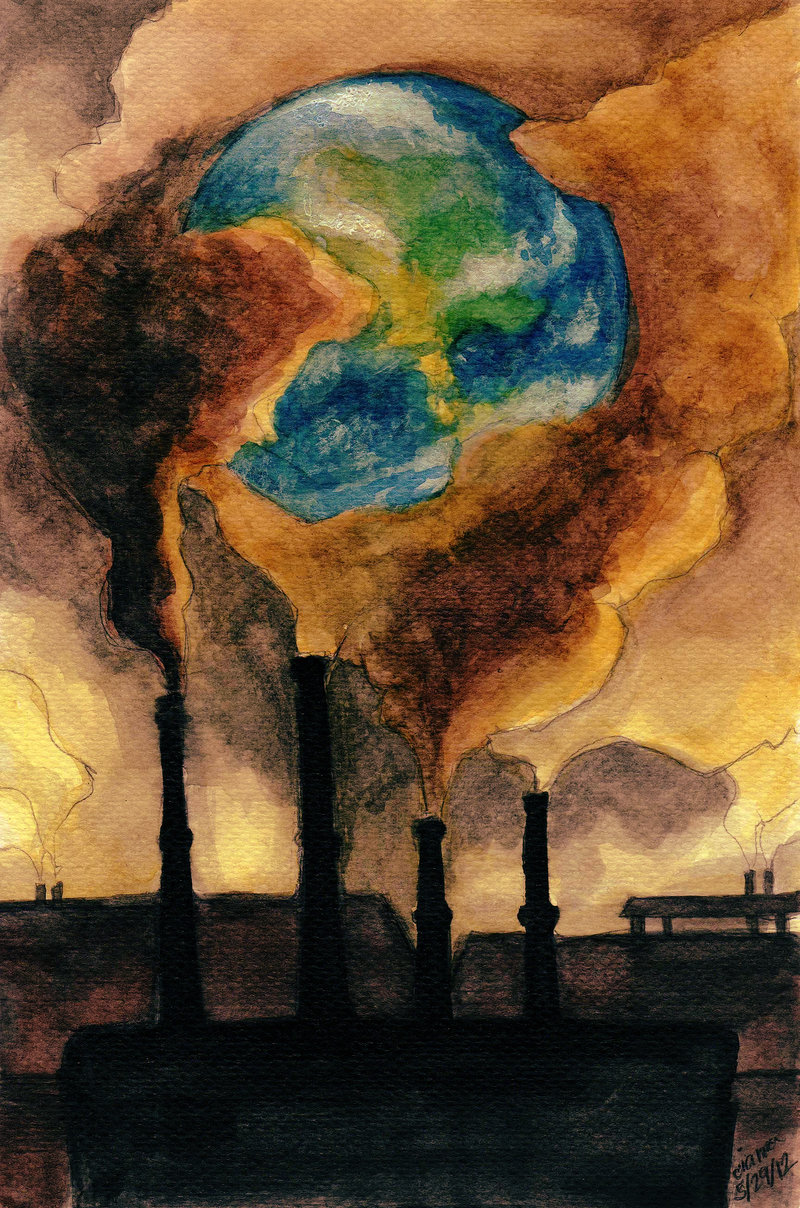
Weathering Climate Change

Filed Under Cloud gazing, Environment, Health, Weather | Leave a Comment

Welcome to the real future: The National Weather Service received 121 reports of possible tornado touchdowns Saturday and early Sunday in Oklahoma, Kansas, Nebraska and Iowa.
This morning also via CNN, five people, including two children, were killed in a suspected tornado in the northwest Oklahoma town of Woodward — the impact of a surging climate change will only make for more and more ‘weird weather.’

My youngest daughter moved to Minneapolis, Minnesota, last August amid concerns on the usually harsh winters up there — yesterday an e-mail response from her on reality: The weather has been soooo weird here. I heard it’s supposed to snow on Monday. Yesterday, it was freeeeezing, and there was a huge thunderstorm and today it was sunny and beautiful. I don’t even know what to think, man.

(Illustration found here).

Join the crowd, kid.
A shitload of people don’t know what to think, either — yet there’s a shitload that do.
From Skeptical Science and Global Warming in a Nutshell:

Global warming is NOT about the daily weather, and there’s no clear connection between global warming and any single hurricane or snow storm or drought.
That’s not the right way to think about it.
Instead, adding energy to the whole Earth System leads to such things as more frequent severe weather events that on average are stronger and more damaging.
That is, it’s a statistical thing that has to do with averages and long-term trends, rather than one’s own experience with the daily weather.

Global warming IS about an overall increase in the amount of energy in the whole Earth System caused by an increase in heat-trapping greenhouse gases.
The experts are only talking about a few degrees of average temperature increase, which doesn’t sound like much, but consider this example.
Imagine a glass of water and ice cubes in a refrigerator whose temperature is set right at the freezing point of water, 0°C or 32°F.
The mixture of ice and water will remain pretty much as it is, but if the temperature is raised by even 1 degree, the ice cubes will start to melt, and at 2 degrees they will melt faster.
Everything was in balance at the old temperature, but at the slightly warmer temperature you eventually end up with all water and no ice, much like what is happening right now to Earth’s Arctic sea ice and mountain glaciers.

What happens when the planet gets warmer?
More extreme weather, disappearing Arctic sea ice, and receding glaciers have consequences, such as less habitable coastal areas, extinction of the polar bears, and disappearing fresh water supplies for billions of people.

Other consequences of global warming include extended droughts and encroaching deserts, increasing wildfires and insect infestations, and changing rainfall and agricultural patterns.

And reality of climate change is reality of the actual-bottom line: For me, this issue is way above politics, it’s about the future of my daughter and my species.
Totally about the size of it (couldn’t have said it better) — only if one has any kind of compassion coupled maybe with any kind of walking-around sense.
Read the whole Skeptical Science post — lots of graphs and charts — and it’s all there, in a nutshell.

Despite a feel of a faraway-happening climate change, the ultimate, immediate end result appears to be found in the weather — the way-near future weather, of say, the middle part of the US now experiencing those tornadoes, is expected have an environment/weather similar to the area in the 1930s, a dust bowl.
Just like a lot of other shit, nature changes, but a warming environment whiplashes those changes, and one is desertification — this phenomenon is occurring in north Africa/southern Europe, and in the US southwest — and oddly weird this shit, desertification also helps accelerate climate change, so thus a real-vicious circle.
On them US arid lands there’s already indicators.
Little, nearly-unnoticeable alterations foretell near-humongous impacts to come, maybe a tiny shift in cow turdage:

Scientists have evidence to believe woody plants began displacing grasslands as a result of overgrazing, but has since been propelled by changing climate.
“If there are too many cattle, they have the same effect as a lawn mower,” Barron-Gafford said.
“They’re tilling the soil, and because they don’t eat the prickly things, they stay away from the established mesquite trees.
But they consume their pods and drop them off in little fertilizer islands.
It’s a perfect formula for landscape change.”

Weather is not climate, as per instructed, and one single event can’t be held accountable to global warming, but it’s the overall path the planet is currently traveling — i.e., similar to walking your dog: The climate is a dog-walker. The weather is his less predictable dog. It’s about as simple and elegant as a way to describe trend and variation — a la climate and weather — as there is.

And the warming of the Arctic influences our overall weather — a new study published last month from the American Geophysical Union reports that rising temperatures in the Arctic would cause associated weather patterns in mid-latitudes to be more persistent, which may lead to an increased probability of extreme weather events that result from prolonged conditions, such as drought, flooding, cold spells, and heat waves.
The folks at Climate Central explain:

The study shows that by changing the temperature balance between the Arctic and mid-latitudes, rapid Arctic warming is altering the course of the jet stream, which steers weather systems from west to east around the hemisphere.
The Arctic has been warming about twice as fast as the rest of the Northern Hemisphere, due to a combination of human emissions of greenhouse gases and unique feedbacks built into the Arctic climate system.

The study contains a stark warning about future weather patterns, given projections showing that Arctic climate change is likely to accelerate in coming years.
“As the Arctic sea ice cover continues to disappear and the snow cover melts ever earlier over vast regions of Eurasia and North America, it is expected that large-scale circulation patterns throughout the northern hemisphere will become increasingly influenced by Arctic amplification,” the study reports.

Last month, an example of the hands-on feel for life via a changing climate and those record warm temperatures:

The magnitude of how unusual the year has been in the United States has alarmed some meteorologists who have warned about global warming.
One climate scientist said it is the weather equivalent of a baseball player on steroids, with old records obliterated.
“Everybody has this uneasy feeling.
This is weird.
This is not good,’’ said Jerry Meehl, a climate scientist who specializes in extreme weather at the National Center for Atmospheric Research in Boulder, Colo.
“It’s a guilty pleasure.
You’re out enjoying this nice March weather, but you know it’s not a good thing.’’

Neither are tornadoes.

As a long-time former resident of the deep south — I grew up in southeast Alabama/northwest Florida — and twisters were a nasty part of our weather systems.
My grandparents on my daddy’s side even had a tornado shelter dug into the side of a hill not far from the house — don’t know if they ever used it (my cousins and I used to play in it), but we all encountered bad weather all along life’s little way living in that particular environment.

Although the actual evidence linking climate change to twisters is apparently not overly-obvious to scientists, there’s a certain wariness to mounting substantiation.
Also at Climate Central, Andrew Freedman wrote shortly after the monster tornado outbreak in April 2011 no discernible trend has been detected in the observational data, and studies of how tornadoes will fare in a warmer world show somewhat conflicting results, but further noted:

Tornadoes are a bigger wild card for climate scientists than other types of extreme weather and climate events, such as heat waves and flooding. (Studies have consistently found that both of these hazards will occur more frequently and severely as the world warms.)

In my own brain it runs like this: The world heats and in doing so creates higher temperatures which make interaction between wind/temperature/moisture more violent, which makes everybody’s weather much-more irrational and mean.
Some of the climate science is over my head and out the window — but a tornado in central California last week, though considered not unusual for this time of year, does perk the ears a bit — and how these brainiacs can figure out how much CO2 was in the air in 1750 is way-beyond me.
But crazy weather I can most-frightfully understand.

Warmer Still — ‘No Way Out’

Filed Under Cloud gazing, Environment, Madness | Leave a Comment

Dramatic changes in climate are being rigged as plot devices for entertainment — ‘Are you not?’
From the New York Times review of the new film, “4:44 Last Day on Earth:”

The cause of the calamity is an environmental breakdown enabled by the human failure to do anything about about climate change.
Or perhaps the hole in the ozone layer; the science is a bit vague.
But the timing of the big finish (referred to in the film’s title) is clear, and though there is an occasional flicker of doubt that it will actually happen, all of the public and private voices of reason and faith seem to agree that there is no way out.

(Illustration found here).

Even as the US has finished a string of record-breaking warm temperatures, described as one of North America’s most extraordinary weather events in recorded history.
Although the Times movie reviewer did not go crazy for ‘4:44,’ the plot device did allow a view of the last day as being somewhat normal — would that be the reality?

One near-fact and leaving that ‘science is a bit vague‘ sense behind — it will be much warmer.
Another round of research finds previous temperature predictions to be above previous expectations:

A new study suggests climate scientists may have underestimated the effect of greenhouse gases, with global temperatures now predicted to rise by between 1.4 and 3 degrees Celsius by 2050.
The study was published in the journal Nature Geoscience by a team of international scientists who ran 10,000 computer simulations of climate models in an attempt to explore the range of global warming predictions made by climate scientists.
The researchers found that while their results matched the predictions made by the Intergovernmental Panel on Climate Change (IPCC) at the lower end, they were higher than earlier predictions at the higher end.

“But it makes me think that people who are thinking about real-world problems, farmers, wine growers in Australia, people managing river catchments for instance, might want to have a look at some of these models to think about what … might plausibly happen, what sorts of changes they might plausibly have to manage for,” he said (Climate-change Professor David Frame at Victoria University of Wellington).
“So one of the real purposes of this is to give planners a chance to … think about scenarios for the future that are physically plausible, are internally consistent, which is an important property and potentially quite practical.”

The professor also doubles up on reality: “If people keep emitting fossil fuels in the way we expect…”
And this is to be expected for the US region: Decreasing snowpack in the western mountains; 5-20 percent increase in yields of rain-fed agriculture in some regions; increased frequency, intensity and duration of heat waves in cities that currently experience them.
Even worse for other parts of the planet, especially in the availability of drinking water.
Some of that shit is already happening — and why climate change is way-way-more than just being entertained.

As in time for young adult crazies — vampires or kids trying to kill one another.
From Climate Progress this morning:

The increase in global climate temperatures has raised concerns about the vampire bat species travelling from Mexico and South and Central America into the southern and central regions of Texas.
Carin Peterson, training and outreach coordinator of the Office of Environmental Health and Safety, said even if vampire bats are not making their appearance, Austin’s surrounding caves and popular bat attraction, Congress Avenue Bridge, already have their annual bat species.
“Biologists are paying attention to the warming climate and what potential impacts that could bring, including non-native wildlife, but this is not something that will likely happen within the next few years,” Peterson said.

Next few years…?
Just don’t go out without a turtleneck — so now, are you entertained?

Gas By Another Name

Filed Under Cloud gazing, Environment, Madness | Leave a Comment

Some joy from the Arctic Methane Emergency Group:

We declare there now exists an extremely high international security risk* from abrupt and runaway global warming being triggered by the end-summer collapse of Arctic sea ice towards a fraction of the current record and release of huge quantities of methane gas from the seabed.
Such global warming would lead at first to worldwide crop failures but ultimately and inexorably to the collapse of civilization as we know it.
This colossal threat demands an immediate emergency scale response to cool the Arctic and save the sea ice.
The latest available data indicates that a sea ice collapse is more than likely by 2015 and even possible this summer (2012).
Thus some measures to counter the threat have to be ready within a few months.

More from the Group, other climate studies, videos and reports can also be found here.

This methane is some way-bad shit — a greenhouse gas 20 times more potent than carbon dioxide.
From the UK’s Independent last December and a piece on the joint US-Russia cruise of the East Siberian Arctic seas.
Igor Semiletov of the International Arctic Research Centre at the University of Alaska Fairbanks, who led the expedition:

“Earlier we found torch-like structures like this but they were only tens of metres in diameter.
“This is the first time that we’ve found continuous, powerful and impressive seeping structures more than 1,000 metres in diameter.
“It’s amazing,” Dr Semiletov said.
“I was most impressed by the sheer scale and the high density of the plumes.
“Over a relatively small area we found more than 100, but over a wider area there should be thousands of them,” he said.

These science guys from all over the world figure there’s hundreds of millions of tons of this methane gas underneath the Arctic permafrost.
And like a lot of other climate-changing articles on studies/reports/findings, the Independent piece also carried the most-usually found phrase in stories of its kind: ‘More/quicker then previous studies/reports/findings anticipated.’
As such: Dr Semiletov’s team published a study in 2010 estimating that the methane emissions from this region were in the region of 8 million tons a year but the latest expedition suggests this is a significant underestimate of the true scale of the phenomenon.

As the earth continues to warm, the permafrost in the Arctic also starts to melt, which in turn allows this methane shit to bubble up to the surface (as described above as “plumes”) through what’s been called “chimneys” — seen in the drawing at the left — and the more heat, the bigger the release.
Two years ago, this process was already getting bad: “The amount of methane currently coming out of the East Siberian Arctic Shelf is comparable to the amount coming out of the entire world’s oceans.”

The same thing down south in the Antarctic region  — and this methane-release sequence is of the quick BOOM variety, as in not much happening, then pop.

(Illustration found here).

The permafrost methane is just fine where it is right now — everything’s cool until released by what scientists call a ‘trigger,’ and in this case, the trigger is the warming earth.
A 2008 study using history reported this heat could trigger an abrupt climate change because very little warming could unleash this trapped methane, and could happen fairly rapidly.
Key word here is abrupt: 1. Unexpectedly sudden; 2. Surprisingly curt; 3. Steeply inclined; and so forth.
Way back in 2004, the Union of Concerned Scientists: The term “abrupt climate change” describes changes in climate that occur over the span of years to decades, compared to the human-caused changes in climate that are occurring over the time span of decades to centuries.
Of course, this was before the real game changer in 2007 with the release of the UN’s IPCC report that determined that is was “unequivocal” the globe was warming, and, us humans were “very likely” the cause of it.
The report started a climate-change shit-storm which continues to this very minute — five years later and assholes still deny what’s now happening right outside their own windows.
One hopes, but…

Natalia’ Shakhova, a colleague at the International Arctic Research Centre at the University of Alaska Fairbanks — from the Independent story:

“I am concerned about this process, I am really concerned. “
But no-one can tell the timescale of catastrophic releases.
“There is a probability of future massive releases might occur within the decadal scale, but to be more accurate about how high that probability is, we just don’t know,” Dr Shakova said.
“Methane released from the Arctic shelf deposits contributes to global increase and the best evidence for that is the higher concentrastion of atmospheric methane above the Arctic Ocean,” she said.

What prompted this particular post was this particular story this morning from the BBC:

An eminent UK engineer is suggesting building cloud-whitening towers in the Faroe Islands as a “technical fix” for warming across the Arctic.
Scientists told UK MPs this week that the possibility of a major methane release triggered by melting Arctic ice constitutes a “planetary emergency.”

Wave energy pioneer Stephen Salter has shown that pumping seawater sprays into the atmosphere could cool the planet.

Towers would be constructed, simplified versions of what has been planned for ships.
In summer, seawater would be pumped up to the top using some kind of renewable energy, and out through the nozzles that are now being developed at Edinburgh University, which achieve incredibly fine droplet size.

I’ve done posts on this terrible accident/event-waiting-to-happen before — and it’s frightening no one seems to be paying much attention to what’s already happening to the earth’s climate, much less the near future, causing Nina Federoff, president of the American Association for the Advancement of Science, to proclaim last month she’s “scared to death” of the serious lack of serious concern for what’s happening to the planet’s environment.

So thusly, the BBC ends its piece:

Depending on the size and location, Prof Salter said that in the order of 100 towers would be needed to counteract Arctic warming.
However, no funding is currently on the table for cloud-whitening.
A proposal to build a prototype ship for about £20m found no takers, and currently development work is limited to the lab.

Cow by any other word.

May’s March Madness

Filed Under Cloud gazing, Environment, Weather | Leave a Comment

Flowers blooming early — spring ain’t til next Tuesday:

“My nightmare now is this weather,” Japanese ambassador to the U.S. Ichiro Fujisaki said at press briefing today at the National Press Building.
“What are we going to do if all the cherry blossoms bloom before we start [the annual National Cherry Blossom Festival]?,” he said.
“That’s my nightmare.”

Well, as the rocker springs to the mocker: Welcome to everybody’s nightmare.

In the warmest winter maybe since 1872, spring has come way-early this year and in the US it’s heat in the east, snow in the west — creating a weather paradox that allows a glimpse into a future of extremes from flooding to drought.

(Illustration found here).

In the last few weeks, reportedly all kinds of record temperatures were recorded in the US and although several reasons are factored into the events, the punch to the heat comes from climate change — as was/is called,”weather on steroids.”
From Climate Central:

On March 13 alone, 184 record high temperatures were broken or tied across the country, according to the National Oceanic and Atmospheric Administration (NOAA).
Between March 6-12, 1,146 warm temperature records (record daily highs and record warm daily lows) were set or tied, compared to just 277 cold temperature records.
In a long-term trend that has been linked to global climate change, daily record-high temperatures have recently been outpacing daily record-lows by an average of 2-to-1, and this imbalance is expected to grow as the climate continues to warm.
According to a 2009 study, if the climate were not warming, this ratio would be expected to be even.

Despite even cooling temperatures in Australia, for an instance of an oddity, a new report shows that the climate is starting to bake real good.
And it’s not going to be pretty: There were further uncertainties relating to tipping points in the climate system, such as the break-up of ice sheets, which could lead to rapid climate change, the report says. “Unless greenhouse gas emissions decrease, we expect to see the temperature of the atmosphere and the oceans continue to warm and sea levels continue to rise at current or even higher rates,” the report says.
Australia’s second State of the Climate report also says the concentration of CO2 in the atmosphere last year was 390 parts per million, higher than at any time for the past 800,000 years.
I haven’t any kind of a clue how these guys figure that shit out, but it don’t look real fun.

In another similar post this morning at Skeptical Science, a lot of numbers and equations and charts are boiled down into language even an idiot like me could understand.
One illustration is how Australia’s Sydney Harbour could be emptied twice a day if all the heat accumulating the earth’s oceans were turned onto one spot — these brainiacs says it’s equal to two Hiroshima bombs going off every second, and this since 1961.
A couple of snips:

But why don’t we notice this?
Because instead of all this heating happening just in Sydney Harbour, this is spread out through out the worlds oceans.
And they are huge: 2,300,000 times the size of Sydney Harbour.
So heat that boils the harbour would only warm the entire ocean by a fraction of a degree.
So we don’t notice it much.
Not that it isn’t real, just that we don’t notice it.
And if this much heat had instead gone into just warming the atmosphere — you know, that thing we call Climate — it would have raised Air temperatures by around 42 °C over the last 1/2 Century!
When I was in kindergarten, in 1961, a hot day at the beach was 35 °C.
Imagine that it was now 77 °C.

When the first analyses of Ocean Heat Content calculated from old temperature data from the oceans where first published in the early 2000′s, they were described as the ‘Smoking Gun’.
Because they were.
They are the primary observational evidence for Global Warming and the human nature of it.

A rose by any other name is a cherry blossom.

‘Scared to Death’

Filed Under Bullshit, Crime, Environment, Lying | Leave a Comment

A small instance of a humongous and worsening situation:

The decline in the chipmunk’s genetic diversity occurred in the relatively short span of 90 years, demonstrating the rapid threat changing climate can represent for a species, a UC Berkeley release said Sunday.

The shift of the living due to a warming environment poses a danger to everything — we and the animals around us can become more vulnerable to the effects of inbreeding, disease and other problems that threaten species survival, and in the sequence of time, can take place very quickly.

(Illustration found here).

And even with our slowest moving living things — trees.
From HuffPost on Saturday:

U.S. Forest Service researchers have confirmed what has long been suspected about a valuable tree in Alaska’s Panhandle: Climate warming is killing off yellow cedar.

Paul Schaberg, a USFS plant pathologist from Burlington, Vt., one of five authors of a paper on the tree that appeared this month in the journal Bioscience:

“As time goes on and climates change even more, other species, other locations, are likely to experience similar kinds of progressions, so you might do well to understand this one so you can address those future things,” Schaberg said.

“I’m looking out my window and we have a dusting of snow at best,” Schaberg said from his Vermont office.
“And the soils are frozen all over the place, which is not the norm at all.
So even just this one component of changing climate — reduced snow packs, its influence on soils and the things that are living in soils, like roots — that is not limited to the yellow cedar story and Alaska.
That’s pertinent to many locations.”

Most likely, climate change and its results will be pertinent to all locations.

Especially within the human body, as disease is a silent, ugly partner to a changing environment.
Sherilee Harper, a Vanier Canada Graduate Scholar in Aboriginal People’s Health at the University of Guelph, describes a near-future of not nice: “Under any climate change scenario you consider, this is going to increase,” she says. “Waterborne diseases are not just an Arctic issue; they are global. The World Health Organization projects that most of the climate change disease burden in the 21st century will be due to diarrhea and malnutrition.”
Hungry, but still on the toilet — what a shitty fix.

Even with all these horrors of climate change breathing down humanity’s collective neck, there’s a strong and well-funded dark side to the mirror of environmental concerns in the form of an organized, nasty denial to science and its near-scream-like warnings.
Not only is the fight against a changing natural earth, but also against some back-stabbing tactics: Leaked documents from a prominent United States conservative think tank show how it sought to teach schoolchildren scepticism about global warming and planned other behind-the-scenes tactics using millions of dollars in donations from big corporate names.
Hard to grasp how these people sleep at night, or even look at their children and grandchildren without feeling like nasty assholes.
And speaking of nasty assholes, Rick Santorum has pushed the prick deep into religion and daddy/momma earth; there’s no way we have to watch what we do with the planet because humans have the power.
Santorum claims global warming is all bullshit.
From TPM:

“We were put on this Earth as creatures of God to have dominion over the Earth, to use it wisely and steward it wisely, but for our benefit not for the Earth’s benefit,” Santorum told a Colorado crowd earlier this month.
He went on to call climate change “an absolute travesty of scientific research that was motivated by those who, in my opinion, saw this as an opportunity to create a panic and a crisis for government to be able to step in and even more greatly control your life.”

One wonders at the hearts, minds and souls of people who believe this crap.

And the whole denial/anti-science horror is starting to shake the investigators.
From the UK’s the Guardian:

Most scientists, on achieving high office, keep their public remarks to the bland and reassuring.
Last week Nina Fedoroff, the president of the American Association for the Advancement of Science (AAAS), broke ranks in a spectacular manner.
She confessed that she was now “scared to death” by the anti-science movement that was spreading, uncontrolled, across the US and the rest of the western world.
“We are sliding back into a dark era,” she said.
“And there seems little we can do about it.
I am profoundly depressed at just how difficult it has become merely to get a realistic conversation started on issues such as climate change or genetically modified organisms.”

“Those of us who grew up in the sixties, when we put men on the Moon, now have to watch as every Republican candidate for this year’s presidential election denies the science behind climate change and evolution.
That is a staggering state of affairs and it is very worrying,” said Professor Naomi Oreskes, of the University of California, San Diego.

“It has taken the scientific community a long time to realise what it is up against,” says Oreskes.
“In the past, it thought the problem was just a matter of education.
All its practitioners had to do was make an effort to reach out and talk to teachers, the public and business leaders.
Then these people would see the issues and understand the need for action.
“But now they are beginning to realise what they are really up against: massive organised attempts to undermine scientific data by people for whom that data represents a threat to their status quo.
Given the power of these people, scientists will have their work cut out dealing with them.”

First, however, a lot of bad shit will take place, a lot of people will die and a lot of irreparable damage done.
Everybody should most-indeed be ‘scared to death,’ but maybe not so much the coming heat, but the Joseph-Goebbels-cruelty of other humans.

« go backkeep looking »