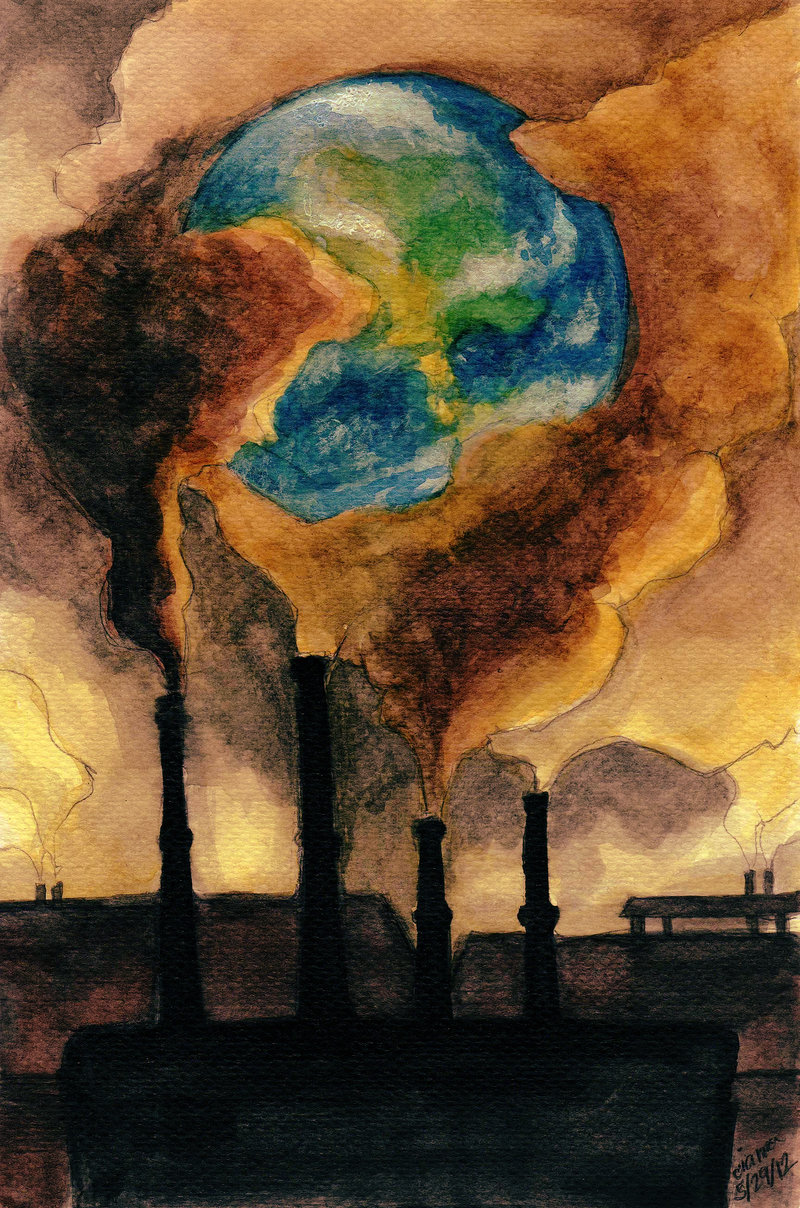
Climate Endgame — Beyond the ‘Tipping Point’

Filed Under Environment, Scratching Sounds | 1 Comment

Here in the wee hours of the last day of May 2011, the world keeps spinning, the rain keeps coming down (along the northern California coast) and bad shit keeps filling CBS’ early-morning-looped-news program, ‘Up to the Minute‘ — repeated stories that’s just flutter in the breeze compared to the horror coming via climate change.

All the evidence harshly points to the planet being near the midpoints or closer to the bad end of a catastrophic break down of the natural world enhanced by mankind’s arrogant, greedy desire for civilization’s tiny, tiny perks.

(Illustration found here).

One of the biggest differences between climate change and other worldly problems is about like the difference between a skeptic and a denier — one has room for change, the other no room at all.
Despite the overwhelming evidence from many divergent sources that indeed the planet is going through a shake-and-bake downsizing, there’s an enormous amount of denial, in other words, denying reality and truth, from a whole shitload of people.
A good look at the skeptic and the denier can be found at ABC News’ The Drum: Genuine skeptics consider all the evidence in their search for the truth. Deniers, on the other hand, refuse to accept any evidence that conflicts with their pre-determined views.
The horror of this: The biggest mouth can make the biggest impression on the enormous mob of unwashed masses.

Another good post on denying the undeniable is at Transition Voice, where Erik Curren now thinks even horrible, weird weather won’t change people’s minds about climate disruption:

When it comes to climate change “denial is still the dominant response,” writes Paul Gilding in The Great Disruption.
“We won’t change at scale until the crisis is full blown and undeniable, until the wind really kicks up speed. But then we will change.”
When I read Gilding’s book I thought it would take something like this year’s historic storms and floods in the Midwest and South to wake Americans from their stupor on climate.
But now I’m not so sure if even climate disaster will be enough.

Curren concludes: The weird weather is here. But the climate denial still isn’t gone. So we clearly can’t count on weird weather to do our political dirty work.

There is some light shining in the darkness.
In a Washington Post editorial earlier this month: Climate-change deniers, in other words, are willfully ignorant, lost in wishful thinking, cynical or some combination of the three. And their recalcitrance is dangerous, the report makes clear, because the longer the nation waits to respond to climate change, the more catastrophic the planetary damage is likely to be — and the more drastic the needed response.

Even as the denials are shown to be dumb-ass, assholes, the world continues to contort, rumble and get more, and more dangerous.

Next week is the annual World Oceans Day, which has been going on since 2003 in order to celebrate and honor the body of water which links us all, for what it provides humans and what it represents.
However, the oceans ain’t pretty anymore.
From the BBC:

Findings from a “natural laboratory” in seas off Papua New Guinea suggest that acidifying oceans will severely hit coral reefs by the end of the century.

The oceans absorb some of the carbon dioxide that human activities are putting into the atmosphere.
This is turning seawater around the world slightly more acidic – or slightly less alkaline.
This reduces the capacity of corals and other marine animals to form hard structures such as shells.
Projections of rising greenhouse gas emissions suggest the process will go further, and accelerate.

“The results are complex, but their implications chilling,” commented Alex Rogers from the University of Oxford, who was not part of the study team.
“Some may see this as a comforting study in that coral cover is maintained, but this is a false perception; the levels of seawater pH associated with a 4C warming completely change the face of reefs.
“We will see the collapse of many reefs long before the end of the century.”

And the situation is getting worse.
From AFP (via Raw Story):

“Energy-related carbon-dioxide (CO2) emissions in 2010 were the highest in history, according to the latest estimates,” the International Energy Agency (IEA) said in a statement.
After a dip in 2009 caused by the global financial crisis, emissions are estimated to have climbed to a record 30.6 gigatonnes (Gt), a five percent jump from the previous record year in 2008, when levels reached 29.3 Gt, the IEA said.

“This significant increase in CO2 emissions and the locking in of future emissions due to infrastructure investments represent a serious setback to our hopes of limiting the global rise in temperature to no more than two degrees C,” said Fatih Birol, the IEA’s chief economist.

The only skepticism I have about climate change is time.
Although in the goodly chunk of those scientific papers on climate there’s talk of real-real-bad shit coming in 2015, or 2020, or the end of the century, etc., but based on evidence outside my window, I think in my total-non-science brain this stuff is already here.
Yes, Virginia, Chicken Little is right on, the sky really is falling.

In a thorough post at the Daily Beast, Sharon Begley, science columnist and science editor of Newsweek, takes a mean-and-nasty look at climate change, taking in account the current freakish US weather — record tornadoes and flooding — and shit going down worldwide, from the heat wave in Russia, floods in Australia and Pakistan to a months-long drought in China.
Some highlights:

From these and other extreme-weather events, one lesson is sinking in with terrifying certainty.
The stable climate of the last 12,000 years is gone.
Which means you haven’t seen anything yet.
And we are not prepared.

The game of catch-up will have to happen quickly because so much time was lost to inaction.
“The Bush administration was a disaster, but the Obama administration has accomplished next to nothing either, in part because a significant part of the Democratic Party is inclined to balk on this issue as well,” says economist Jeffrey Sachs, head of the Earth Institute at Columbia University.
“We [are] past the tipping point.”
The idea of adapting to climate change was once a taboo subject.
Scientists and activists feared that focusing on coping would diminish efforts to reduce carbon emissions.
On the opposite side of the divide, climate-change deniers argued that since global warming is a “hoax,” there was no need to figure out how to adapt.
“Climate-change adaptation was a nonstarter,” says Vicki Arroyo, executive director of the Georgetown Climate Center.
“If you wanted to talk about that, you would have had to talk about climate change itself, which the Bush administration didn’t want to do.”
In fact, President Bush killed what author Mark Hertsgaard in his 2011 book, Hot, calls “a key adaptation tool,” the National Climate Assessment, an analysis of the vulnerabilities in regions of the U.S. and ideas for coping with them.
The legacy of that: State efforts are spotty and local action is practically nonexistent.
“There are no true adaptation experts in the federal government, let alone states or cities,” says Arroyo. “They’ve just been commandeered from other departments.”

So what lies behind America’s resistance to action?
Economist Sachs points to the lobbying power of industries that resist acknowledgment of climate change’s impact.
“The country is two decades behind in taking action because both parties are in thrall to Big Oil and Big Coal,” says Sachs.
“The airwaves are filled with corporate-financed climate misinformation.”

Maybe, the only thing we can actually do now is “hold on to your butts.”

Or be like the next US president, Sarah Palin, blubbering nonsense again this past weekend while astride a big, ole Harley, “I love that smell of the emissions.”

Dr. Methane Gun, Or, How I Learned to Stop Worrying and Love Extinction

Filed Under Cloud gazing, Environment | Leave a Comment

In viewing climate change, every so often there comes along some aspect of that horror-in-coming that’s even more morbid, more dark-cast depressing than normal, and one of those is the impact of methane gas deposits blasting out of the Arctic permafrost (or permamelt, ha,ha,HA) thawing at an accelerating rate, beyond predictions.

These methane ‘burps’ are nothing new — I’ve posted on the phenomenon before — but this process continues and the terror is this: Underground stores of methane are important because scientists believe their sudden release has in the past been responsible for rapid increases in global temperatures, dramatic changes to the climate, and even the mass extinction of species.

(Illustration found here).

Joe Romm at Climate Progress: Methane release from the not-so-perma-frost is the most dangerous amplifying feedback in the entire carbon cycle…Methane (CH4) deserves attention it is such a highly potent greenhouse gas — 25-33 times more powerful than carbon dioxide (CO2) over a 100-year time-horizon, but as much as 100 time more potent over 20 years…
And last year, the National Science Foundation released this:

The research results, published in the March 5 edition of the journal Science, show that the permafrost under the East Siberian Arctic Shelf, long thought to be an impermeable barrier sealing in methane, is perforated and is starting to leak large amounts of methane into the atmosphere.
Release of even a fraction of the methane stored in the shelf could trigger abrupt climate warming.
“The amount of methane currently coming out of the East Siberian Arctic Shelf is comparable to the amount coming out of the entire world’s oceans,” said Shakhova, a researcher at UAF’s International Arctic Research Center.
“Subsea permafrost is losing its ability to be an impermeable cap.”

In a post yesterday, Romm explored a new Geophysical Research Letters study on a long-ago methane eruption and how that’s extremely pertinent right now.
A couple of nuggets:

Methane (CH4) is an extremely potent greenhouse gas, 20-30 times more powerful than carbon dioxide (CO2) on a century timescale.
Fortunately it normally occurs in very low concentration in the atmosphere — about 0.3 to 0.4ppm during glacial periods and 0.6 to 0.7ppm during warmer periods.
In 1750 the concentration was ~0.7ppm.
By 2010 it had reached >1.8ppm, and is now at its highest level in 500,000 years.
This is largely due to human activity, particularly the keeping of large herds of cattle and flocks of chickens and the production of fossil fuels.
Methane has a relatively short life in the atmosphere where it oxidizes into CO2 over a period of 9-15 years.

Very rapid and massive release of carbon deficient in ∂13C, does put one in mind of the Methane Gun hypothesis.
It postulates that methane clathrate at shallow depth begins melting and through the feed-back process accelerate atmospheric and oceanic warming, melting even larger and deeper clathrate deposits.
The result: A relatively sudden massive venting of methane — the firing of the Methane Gun.
Recent discovery by Davy et al (2010) of kilometer-wide (ten 8-11 kilometer and about 1,000 1-kilometer-wide features) eruption craters on the Chatham Rise seafloor off New Zealand adds further ammunition to the Methane Gun hypothesis.

While natural global warming during the ice ages was initiated by increased solar radiation caused by cyclic changes to Earth’s orbital parameters, there is no evident mechanism for correcting Anthropogenic Global Warming over the next several centuries.
The latter has already begun producing methane and CO2 in the Arctic, starting a feedback process which may lead to uncontrollable, very dangerous global warming, akin to that which occurred at the PETM.
This extremis we ignore – to our peril.

Romm adds: It is worth noting that no climate model currently incorporates the amplifying feedback from methane released by a defrosting tundra. Indeed the NSIDC/NOAA study I wrote about in February on methane release by the land-based permafrost itself doesn’t even incorporate the carbon released by the permafrost carbon feedback into its warming model!

So now, Major ‘King’ Kong can instead ride that methane gun into oblivion.

Climate Chatter — Fiddling with the Fiddler

Filed Under Cloud gazing, Environment | Leave a Comment

Even as radioactivity from Japan’s shredded Fukushima nuclear plant has been detected all over the globe, from China to the eastern part of the US, one killjoy piped up: Lake Barrett, a nuclear engineer and former staffer for the U.S. Nuclear Regulatory Commission, said the risk of exposure from the Fukushima plant is very small, “much less than that we encounter in everyday life.”
Infamous last words, most likely.

And who knows the impact this has on ever-accelerating climate change — can’t be good.

(Illustration found here via Google Images).

A brittle example of bad news washed clean by bullshit is the ongoing lawsuit in Ecuador between Ecuadorean indigeneous people and oil giant Chevron, which entered a new phase Monday when a new three-judge panel was installed to analyze the entire case, all 215,000 pages.
Last month, an Ecuadorean court ordered Chevron to pay $9.46 billion in damages, including $860 million for the Amazon Defense Front, a coalition formed by the plaintiffs, but both Chevron and the Ecuadorian plaintiffs appealed the ruling.
From the Wall Street Journal this bit: While plaintiffs appealed the ruling asking for the awarded amount to be increased, Chevron has said that its appeal is tied to the evidence, saying that the plaintiffs’ lawyers falsified data and pressured scientific experts to find contamination where none existed.
Some more of that famous bullshit last words.
Read a background of the Ecuador/Chevron legal mess here.

In the US House this Thursday is a full Science Committee meeting, titled Climate Change: Examining the Processes Used to Create Science and Policy, but most of those scheduled to blubber their thoughts on the matter are climate-change-denying assholes.
And as DeSmogBlog put it, the whole shebang is another display of agnotology, which is the study of culturally-induced ignorance or doubt, particularly the publication of inaccurate or misleading scientific data.
Just as Rome the US burns.

And all this as another UN climate report indicates that earth’s cities will be the front line on the horrors of climate change and its horrendous side effects.
From the BBC:

The assessment by UN-Habitat said that the world’s cities were responsible for about 70% of emissions, yet only occupied 2% of the planet’s land cover.
While cities were energy intensive, the study also said that effective urban planning could deliver huge savings.
The authors warned of a “deadly collision between climate change and urbanisation” if no action was taken.

Joan Clos, executive director of UN-Habitat, said the global urbanisation trend was worrying as far as looking to curb emissions were concerned.
“We are seeing how urbanisation is growing – we have passed the threshold of 50% (of the world’s population living in urban areas),” he told BBC News.
“There are no signs that we are going to diminish this path of growth, and we know that with urbanisation, energy consumption is higher.
According to UN data, an estimated 59% of the world’s population will be living in urban areas by 2030.
Every year, the number of people who live in cities and town grows by 67 million each year – 91% of this figure is being added to urban populations in developing countries.
The main reasons why urban areas were energy intensive, the UN report observed, was a result of increased transport use, heating and cooling homes and offices, as well as economic activity to generate income.

And if one wanted to see what happens to big cities in trouble with its environment, just look at Japan’s current situation.
Via The Seattle Times:

Tokyo’s iconic electronic billboards have been switched off.
Trash is piling up in many northern cities because garbage trucks don’t have gasoline.
Public buildings go unheated.
Factories are closed, in large part because of rolling blackouts and because employees can’t drive to work with empty tanks.
This is what happens when a 21st-century, technologically sophisticated country runs critically low on energy.
The March 11 earthquake and tsunami have thrust much of Japan into an unaccustomed dark age that could drag on for up to a year.
“It is dark enough to be a little scary. … To my generation, it is unthinkable to have a shortage of electricity,” said Naoki Takano, 25, a pony-tailed salesman at Tower Records in Tokyo’s Shibuya district, normally infused by neon lights.

Grease up the strings there, Nero.

Secrets So Complex

Filed Under Economy, Energy, Environment, Scratching Sounds | Leave a Comment

Last year’s BP oil spill will apparently exacerbate our slide down the backside of peak oil — from Consumer Energy Report today — Further: The 220,000 barrel per day loss will be made up by importing more oil, and the loss of that oil from the market will add to the upward pressure on oil prices. There will be some savings from conservation as prices continue to climb, but mostly the shortfall will just result in billions more dollars that will flow out of the U.S.

And this on the sense that those peoples in charge of production numbers are not telling the truth.

According to Business Insider, oil production had a ‘very disappointing’ 2010 in that production is running at 2005 levels — another pie-hole in the purpose of peak oil — given even the non-OPEC sources, i.e., like the massive Cantarell field in Mexico, dropping 800,000 barrels per day, down from a ‘peak‘ of 3.4 million barrels per day five years ago, and the big, important North Sea region (produced via the Brits, Norway, Denmark, Netherlands, Germany) has just lost 25% of its production in less than 24 months, falling over a million barrels a day.

(Illustration found here).

The record keeping of oil production levels is a complex, twisted doo-doo of a misrepresentation — another numbers game.
Also from Business Insider:

One of the methods EIA Washington and IEA Paris have increasingly relied on in recent years to obscure the very serious and now very real problem of oil depletion is to include biofuels and natural gas liquids in the accounting of global oil production.
The technique that both agencies use to conduct this obfuscation is a familiar one, in which the key information is aggregated (buried) into a much larger barrage of data and presentations.
For a scholarly look at the methods governments use to work around their obligations to inform the public, do watch the one hour lecture that Jay Rosen gave to the World Bank earlier this year.
Rosen’s deconstructions of the media have been very helpful to me, over the past two years. See his blog here: PressThink.org.
Rosen describes the use of opacity as a kind of hiding in plain sight, or secrecy by complexity.
In order to rebut this Secrecy by Complexity it’s the obligation of responsible energy analysts to explain the falsehood of adding biofuels and natural gas liquids to measures of oil production.
The reason is simple: natural gas liquids are not oil, and they contain only 65% of the BTU of oil. Worse, biofuels are barely an energy source themselves and are the product of a conversion process of other energy inputs. Accordingly, the world is not producing 84, or 85, or 86 million barrels of oil per day.
Nor will the depletion of oil be solved by the production of biofuels in the future.
When the EIA in Washington falsely composes such forecasts, aggregating future natural gas liquids and ethanol into a supply picture for “oil” as they do each year in The Annual Energy Outlook, this disables the public’s ability to accurately understand the true outlook for global oil supply.
It’s not surprising that the government uses opacity and secrecy by complexity to handle this extremely important issue.
The loss of cheap energy, the loss of the cheap BTU that oil has provided to OECD nations for the past 70 years, is a crucial factor in the dilemma the West now faces: a newly chronic economic restraint that refuses to go away.

There’s also the demand versus production theory — a good explanation found here — in which as the production of oil declines, the demand also declines.

The future is still not so bright either way.

Weekend Wanking

Filed Under Cloud gazing, Musings, Orwellian | Leave a Comment

“But February made me shiver
With every paper I’d deliver.
Bad news on the doorstep;
I couldn’t take one more step.

– ‘American Pie,’ Don McLean

Surfing Internet news sites can be overly-depressing.
Any kind of news nowadays is depressing — beware of those bearing glad tidings, they either don’t want to upset you, or they’re lying through their ass.
How could anyone doubt climate change with this story on the home page of the New York Times?
Or this from the UK’s top soldier?
Or this study, which revealed daydreaming makes one unhappy: “A human mind is a wandering mind, and a wandering mind is an unhappy mind.”
There’s just no escape.

(Illustration found here).

Apparently with no escape, the situation will only worsen — the next couple, if not a few years ahead for the US of A won’t be pretty, which in turn will drag-down the rest of the world as humanity slowly extinct’s itself and all other species living on this piece of rock hurtling toward Mr. and Mrs. Oblivion.
And this just ain’t no piece of rock-n-roll bullshit.

Overall Situational Disheartenment Disorder — OSDD — a distant, nearly-unknown relative to Post-Traumatic Stress Disorder — PTSD — and although the vast, vast majority of most OSDD cases are non-violent, some sufferers are known to lock themselves in air-tight rooms and watch “13 going on 30” for hours on end.
And although there’s been absolute-zero actual scientific research done on OSDD, the symptoms, causes/effects are floating in the eyes of humanity’s traffic.
OSDD is in the air, vibrating the eardrums, soaking up the eye-sockets — OSDD is carried by news, news from a neighbor, from a relative, from across town, down south, across the country, across the planet — you get the picture.
A picture painted by a 24/7/365 news cycle on a variety of media — the daydreaming study mentioned above was conducted via iPhone.
Unlike PTSD, OSDD is not after the fact, it comes prior to the fact, and stays way-after.
So any current news from just about any source only reinforces, or at minimum, facilitates disheartenment.

OSDD was strong this weekend, and coupled with a blah weather condition up here in northern California, the desire to write was scotched at every turn — I started three posts yesterday, trashed one and ended up with nothing.
A writer of sadness only when feeling at least nearly happy, I instead took an extra-long nap.

Loudness
– Judy Brown

After bad news, and its pulled-back fist,
flows in a sound that’s not a sound. It’s not
the brain’s tide beating blood in propped
and shored-up workings, not the tapestried
texture of attended silence, the goffering
of quiet air folding and unfolding
in a house where nothing is happening.

After bad news, you tell the seconds,
hungry for the hurrying thunder
that never comes. Instead a chemical fizz
fills the ears, before the descaling. An angel
rides the stirrup and anvil, spurring on the drum,
works like wild weather in wet sheets,
flapping and cracking the body’s flat muscles.

Long after the bad news, when it’s bedded in,
you notice most clearly the mild loudness
of the not-so-old man in the foot tunnel,
drumming and drumming and biting his mouth.
The posed coins in his blue cloth
are tiny, like a cast handful of ear-bones.

And tomorrow is tomorrow is Monday!

« go backkeep looking »