Pump-U-Up

Filed Under Cloud gazing, Energy, Environment, Madness | Leave a Comment

In the midst of people/places/things making news this week, one item seemingly absent is any hysteria over high fuel prices.

Competition for news time is tight, with the vernal Dick Clark dead at 82, Leon Panetta trying to explain away another Afghan horror photo as “…not who we are…,” three SS agents forced out in a widening whore scandal, Syria not keeping its word on a ceasefire (Duh!), and, even maybe Mitt Romney slapping a terrible put-down on some cookies, prompting the baker to proclaim: “Let him eat cake next time.”
And so it goes…

But where’s the oil?

Outside the urgency circle — for the first time in two-and-a-half months, US gas pump prices declined last week, and with it, the nation’s drivers are staying closer to home with consumption down 4 percent from the same time last year.

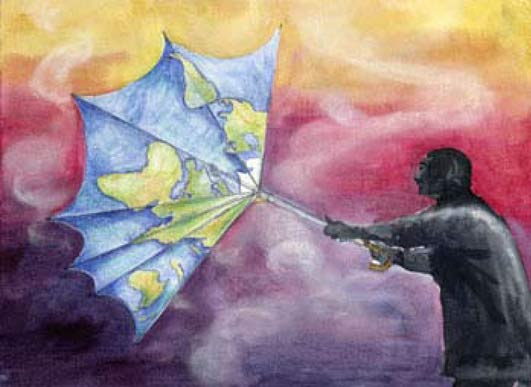
(Illustration found here).

Due to oil supplies growing, oil prices are skimming the milk — US inventory grew by 3.9 million barrels last week on “…some pretty anemic fuel demand levels.”
Also via Bloomberg: Benchmark West Texas Intermediate crude fell $1.53 to finish at $102.67 per barrel in New York, while Brent crude lost 81 cents to end at $117.97 per barrel in London.
Meanwhile, on the street-level pump time: U.S. retail gasoline prices dipped slightly to a national average of $3.899 per gallon, according to AAA, Wright Express and Oil Price Information Service. The national average has declined by 2.6 cents this month, and it’s now it’s just barely under $3.90 for the first time since March.

Although pump prices are down right now, they’re supposed to chart upward as we approach the summer time.

So, to do my part, I put another $20 worth of gas in the still-chugging Jeep yesterday, the pump price still at $4.49 a gallon for regular — the same the past month.
Still higher than the rest of California: The average cost of a gallon of regular in California is still 6.5 cents higher than it was at this time last year, at $4.245. But that is a drop of 4.5 cents a gallon since last week and a drop of 11.6 cents since last month.
What a gas.

No, it’s really an inferno and no one is watching.
The most-major problem with oil — fossil fuels in general — is not gas pump prices, or demand or consumption, but what the shit is doing to life on this freaked-out planet.
Oh, there’s still plenty of oil, though, it’s near the end of the so-called ‘easy oil,’ but still enough to kill every living creature now alive.
From European Energy Review under the title, ‘Cheer Up: The World has plenty of oil,’ on how we might be f*cked:

It’s widely believed nowadays that global oil production is running up against its limits.
“The days of easy oil are over”, we are told and we should brace ourselves for an age of relative oil scarcity.
The reality, however, is very different.
As more and more people within the oil industry have come to realize in recent years, the world has plenty of oil that can be produced at competitive prices for a long, long time to come.
This means the world does not face inevitable “energy poverty” and there is no reason to be afraid of unavoidable “energy wars.”

The author then explains in some detail how OPEC effects oil production, how the growth of unconventional fuels, demand and other factors in revealing there’s still enough fuel to keep civilization blasting into a far distant future.
It’s a horror tale.

There’s way more oil than earth.
From the Natural Resources Defense Council last week: More importantly, we were always going to run out of the earth’s capacity to absorb carbon dioxide without suffering catastrophic climate disruption long before we ran out of fossil fuels.
Via Climate Progress and Jonathan Koomey:

I focus here on the lower bounds to make an important point: Even with estimates of the fossil fuel resource base at the low end of what the literature says, the amount of carbon embodied in just the conventional sources of these fuels is vastly larger than the amount of fuel assumed to be burned in the MIT no-policy case (which is a reasonable assessment of our “business-as-usual” future, assuming no major efforts to wean ourselves off of fossil fuels).

I conclude from this comparison that there’s virtually no chance that resource constraints would provide a brake on carbon emissions in this century, and the emissions in the MIT no-policy case are below what could be expected if we were to burn even a quarter of our entire conventional resource base in the next ninety years.

One implication of these results is that the current estimated value of fossil fuel reserves (as capitalized in the stock prices of fossil fuel companies) is an illusion, as Dave Roberts of Grist points out.
We quite literally can’t burn it all and continue the orderly development of human civilization, so the trillions of dollars of “value” in those reserves is a mirage (and a major impediment to progress on this problem, given how hard the fossil fuel industry is fighting to preserve its profits).

So in other words, we ain’t ever gonna stop doin’ what we doin’ until we can’t do it any more.
Then it’s extinction time — pump that into your new SUV.

Weathering Climate Change

Filed Under Cloud gazing, Environment, Health, Weather | Leave a Comment

Welcome to the real future: The National Weather Service received 121 reports of possible tornado touchdowns Saturday and early Sunday in Oklahoma, Kansas, Nebraska and Iowa.
This morning also via CNN, five people, including two children, were killed in a suspected tornado in the northwest Oklahoma town of Woodward — the impact of a surging climate change will only make for more and more ‘weird weather.’

My youngest daughter moved to Minneapolis, Minnesota, last August amid concerns on the usually harsh winters up there — yesterday an e-mail response from her on reality: The weather has been soooo weird here. I heard it’s supposed to snow on Monday. Yesterday, it was freeeeezing, and there was a huge thunderstorm and today it was sunny and beautiful. I don’t even know what to think, man.

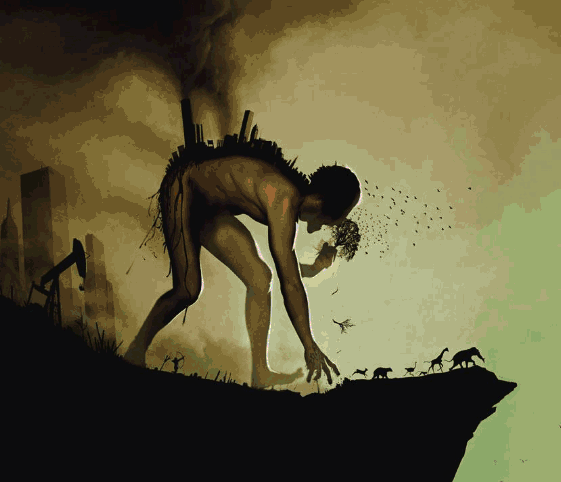
(Illustration found here).

Join the crowd, kid.
A shitload of people don’t know what to think, either — yet there’s a shitload that do.
From Skeptical Science and Global Warming in a Nutshell:

Global warming is NOT about the daily weather, and there’s no clear connection between global warming and any single hurricane or snow storm or drought.
That’s not the right way to think about it.
Instead, adding energy to the whole Earth System leads to such things as more frequent severe weather events that on average are stronger and more damaging.
That is, it’s a statistical thing that has to do with averages and long-term trends, rather than one’s own experience with the daily weather.

Global warming IS about an overall increase in the amount of energy in the whole Earth System caused by an increase in heat-trapping greenhouse gases.
The experts are only talking about a few degrees of average temperature increase, which doesn’t sound like much, but consider this example.
Imagine a glass of water and ice cubes in a refrigerator whose temperature is set right at the freezing point of water, 0°C or 32°F.
The mixture of ice and water will remain pretty much as it is, but if the temperature is raised by even 1 degree, the ice cubes will start to melt, and at 2 degrees they will melt faster.
Everything was in balance at the old temperature, but at the slightly warmer temperature you eventually end up with all water and no ice, much like what is happening right now to Earth’s Arctic sea ice and mountain glaciers.

What happens when the planet gets warmer?
More extreme weather, disappearing Arctic sea ice, and receding glaciers have consequences, such as less habitable coastal areas, extinction of the polar bears, and disappearing fresh water supplies for billions of people.

Other consequences of global warming include extended droughts and encroaching deserts, increasing wildfires and insect infestations, and changing rainfall and agricultural patterns.

And reality of climate change is reality of the actual-bottom line: For me, this issue is way above politics, it’s about the future of my daughter and my species.
Totally about the size of it (couldn’t have said it better) — only if one has any kind of compassion coupled maybe with any kind of walking-around sense.
Read the whole Skeptical Science post — lots of graphs and charts — and it’s all there, in a nutshell.

Despite a feel of a faraway-happening climate change, the ultimate, immediate end result appears to be found in the weather — the way-near future weather, of say, the middle part of the US now experiencing those tornadoes, is expected have an environment/weather similar to the area in the 1930s, a dust bowl.
Just like a lot of other shit, nature changes, but a warming environment whiplashes those changes, and one is desertification — this phenomenon is occurring in north Africa/southern Europe, and in the US southwest — and oddly weird this shit, desertification also helps accelerate climate change, so thus a real-vicious circle.
On them US arid lands there’s already indicators.
Little, nearly-unnoticeable alterations foretell near-humongous impacts to come, maybe a tiny shift in cow turdage:

Scientists have evidence to believe woody plants began displacing grasslands as a result of overgrazing, but has since been propelled by changing climate.
“If there are too many cattle, they have the same effect as a lawn mower,” Barron-Gafford said.
“They’re tilling the soil, and because they don’t eat the prickly things, they stay away from the established mesquite trees.
But they consume their pods and drop them off in little fertilizer islands.
It’s a perfect formula for landscape change.”

Weather is not climate, as per instructed, and one single event can’t be held accountable to global warming, but it’s the overall path the planet is currently traveling — i.e., similar to walking your dog: The climate is a dog-walker. The weather is his less predictable dog. It’s about as simple and elegant as a way to describe trend and variation — a la climate and weather — as there is.

And the warming of the Arctic influences our overall weather — a new study published last month from the American Geophysical Union reports that rising temperatures in the Arctic would cause associated weather patterns in mid-latitudes to be more persistent, which may lead to an increased probability of extreme weather events that result from prolonged conditions, such as drought, flooding, cold spells, and heat waves.
The folks at Climate Central explain:

The study shows that by changing the temperature balance between the Arctic and mid-latitudes, rapid Arctic warming is altering the course of the jet stream, which steers weather systems from west to east around the hemisphere.
The Arctic has been warming about twice as fast as the rest of the Northern Hemisphere, due to a combination of human emissions of greenhouse gases and unique feedbacks built into the Arctic climate system.

The study contains a stark warning about future weather patterns, given projections showing that Arctic climate change is likely to accelerate in coming years.
“As the Arctic sea ice cover continues to disappear and the snow cover melts ever earlier over vast regions of Eurasia and North America, it is expected that large-scale circulation patterns throughout the northern hemisphere will become increasingly influenced by Arctic amplification,” the study reports.

Last month, an example of the hands-on feel for life via a changing climate and those record warm temperatures:

The magnitude of how unusual the year has been in the United States has alarmed some meteorologists who have warned about global warming.
One climate scientist said it is the weather equivalent of a baseball player on steroids, with old records obliterated.
“Everybody has this uneasy feeling.
This is weird.
This is not good,’’ said Jerry Meehl, a climate scientist who specializes in extreme weather at the National Center for Atmospheric Research in Boulder, Colo.
“It’s a guilty pleasure.
You’re out enjoying this nice March weather, but you know it’s not a good thing.’’

Neither are tornadoes.

As a long-time former resident of the deep south — I grew up in southeast Alabama/northwest Florida — and twisters were a nasty part of our weather systems.
My grandparents on my daddy’s side even had a tornado shelter dug into the side of a hill not far from the house — don’t know if they ever used it (my cousins and I used to play in it), but we all encountered bad weather all along life’s little way living in that particular environment.

Although the actual evidence linking climate change to twisters is apparently not overly-obvious to scientists, there’s a certain wariness to mounting substantiation.
Also at Climate Central, Andrew Freedman wrote shortly after the monster tornado outbreak in April 2011 no discernible trend has been detected in the observational data, and studies of how tornadoes will fare in a warmer world show somewhat conflicting results, but further noted:

Tornadoes are a bigger wild card for climate scientists than other types of extreme weather and climate events, such as heat waves and flooding. (Studies have consistently found that both of these hazards will occur more frequently and severely as the world warms.)

In my own brain it runs like this: The world heats and in doing so creates higher temperatures which make interaction between wind/temperature/moisture more violent, which makes everybody’s weather much-more irrational and mean.
Some of the climate science is over my head and out the window — but a tornado in central California last week, though considered not unusual for this time of year, does perk the ears a bit — and how these brainiacs can figure out how much CO2 was in the air in 1750 is way-beyond me.
But crazy weather I can most-frightfully understand.

Bottom’s Up Monday

Filed Under Cloud gazing, Environment, history | Leave a Comment

Monday morning — again.
And in these way-pre dawn hours here on California’s northern coast there’s quiet and peace and a bit warmer than normal.
Just from the my perch, the world appears A-Okay, but beyond this little blurb spot there’s all kind of shit going on and most of it real bad.

Beyond the death of Mike Wallace, the news also appears hushed, though, it’s only the early Monday pocket of time restraints painted across the coming history of our dying planet — people in Europe are up and rolling while in the eastern US daylight probably is starting to tweak the dark.

(Illustration found here).

Basking in the quiet — outside with a smoke and a cup of tea only the roar of the not-peaceful Pacific can be heard in the dark — while across this wretched and tortured planet there’s millions and millions and millions of people who will face the dawn without food, water or hope.
While in the US, we keep sleeping in naive, near-thoughtless dreams of the American Dream — not many of us have ever heard of Dimitris Christoulas, a 77-year-old retired pharmacist who committed suicide last week in Athens — the horror of life just too much.

“Those who should have committed suicide  –  who should have committed suicide a long time ago — are the politicians who knowingly decided to bring this country and its people to this state of affairs,” said Panos Kammenos, a conservative lawmaker who recently set up the Independent Greeks anti-austerity party.

Meanwhile, in the US there’s a similar event awaiting even as our politicians are doing the exact same thing — witness the foam off nit-twit Paul Ryan’s GOP budget proposal, a piece of shit even Forbes calls “A Mistake of Historic Proportions” and if passed a shit load of US peoples would become Dimitris Christoulas.
Read Paul Krugman’s most-excellent dissection this morning of the Ryan budget here.

And in handling the greatest threat to humanity in maybe its entire history — climate change — US peoples are bundled in stupid, cuddled by big GOP mouths full of dog shit.
Americans are safe and secure, or so…
Ron Kramer, a sociologist at Western Michigan University in Kalamazoo, explained we US peoples feel exceptional: Another cultural factor, “American exceptionalism,” celebrates our way of life, which has given us a bounty of wealth and material goods. We want to continue this life, feel we deserve it and believe that nothing bad will happen to us if we do, Kramer explained.
Just wait…

The problem is we’re full of shit in an era of way-diminishing shit.
We’re eating through 1.5 earths every day — so we need 50 percent more earth to keep up with our eating.
Paul Gilding, author of “The Great Disruption: Why the Climate Crisis Will Bring On the End of Shopping and the Birth of a New World ,” posted a noteworthy essay yesterday at CNN on how we’re approaching the point where the dinner table will become bare.
A few points:

For 50 years the environmental movement has unsuccessfully argued that we should save the planet for moral reasons, that there were more important things than money.
Ironically, it now seems it will be money — through the economic impact of climate change and resource constraint — that will motivate the sweeping changes necessary to avert catastrophe.
The reason is we have now reached a moment where four words — the earth is full — will define our times.
This is not a philosophical statement; this is just science based in physics, chemistry and biology. There are many science-based analyses of this, but they all draw the same conclusion — that we’re living beyond our means.

Even the previous heresy, that economic growth has limits, is on the table.
Belief in infinite growth on a finite planet was always irrational, but it is the nature of denial to ignore hard evidence.
Now denial is evaporating, even in the financial markets.
As influential fund manager Jeremy Grantham of GMO says: “The fact is that no compound growth is sustainable. If we maintain our desperate focus on growth, we will run out of everything and crash.” Or as peak oil expert Richard Heinberg argues, we are moving beyond peak oil and into “peak everything.”

In this case, the crisis will be global and will manifest as the end of economic growth, thereby striking at the very heart of our model of human progress.
While that will make the task of ending denial harder, it also means what’s at risk is, quite simply, everything we hold to be important.
The last time this happened was World War II, and our response to that is illustrative of both the denial and delay process and the likely form our response to this crisis will take.

Denial will keep plowing the dead field if ass-wipes like the GOP keep humping the waitress.

Mosquito Maneuver

Filed Under Cloud gazing, Environment, Weather | Leave a Comment

In this past winter of our heated content, all those warm, blissful days in February and March — TVed from Chicago, New York and all points east — them soothing temperatures also created an incubator for weird, and possibly some bad shit.

Dr Alison Donnelly of Trinity College Dublin’s Centre for the Environment on the near-simplicity of near-abrupt climate change: “We are seeing a very clear signal and seeing the effects in our back gardens,” she said. “People are saying they have to cut the grass all year long.”
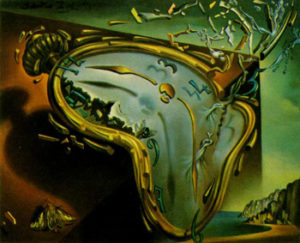
(Illustration found here).

In other words, all the warming indicates the tropics are shifting north — sorta like Margaritaville moving to Cleveland, but way-without benefits.
Dr. Donnelly from above also said this: “Phenology is the only real climate-change indicator that looks at how the change affects plant and animal life. It is also a really good way to convince policy makers about the reality of climate change.”
Good fortune on that last one there, lady.

According to Wikipedia, phenology is the study of periodic plant and animal life cycle events and how these are influenced by seasonal and interannual variations in climate.
In other words, at the end of the line, how the weather effects living organisms, plant or animal.
Climate change, from what I’ve seen and gathered in just last four years or so, plays itself out in weather — locally, regionally, nationally, and continent, or even hemisphere.
Warm temperatures this year in the US Great Lakes area resulted in an early arrival of insects that trout love to eat — Richard Merritt, professor of entomology (the study of insects) at Michigan State University: “The life cycle is based on heat over time,” Merritt said. “Once they gather enough heat units in their bodies, they’ll move on to the next stage. If it’s warm they’ll emerge.”
Those insects, however, have been indigenous to that region for a lengthy while, but changes in the climate in the form of heat brings outsiders — one of those is the asshole mosquito, especially the Aedes aegypti, also known as the yellow-fever mosquito.

From the CDC on why this particular brand is bad news:

…because they have adaptations to the environment that make them highly resilient, or with the ability to rapidly bounce back to initial numbers after disturbances resulting from natural phenomena (e.g., droughts) or human interventions (e.g., control measures).
One such adaptation is the ability of the eggs to withstand desiccation (drying) and to survive without water for several months on the inner walls of containers.
For example, if we were to eliminate all larvae, pupae, and adult Ae. aegypti at once from a site, its population could recover two weeks later as a result of egg hatching following rainfall or the addition of water to containers harboring eggs.

Two years ago, Florida had its first outbreak of dengue fever (the poison carried by the mosquito) since 1934, and other cases have been reported at the Texas/Mexico border.
Although recent studies have shown a warming climate reduces infectiousness, the higher temperatures make for a wider range, so the result can be complicated, but not in a good way.
Links have been established between global warming and infectious disease — diarrhea, cholera, tick-borne illness, anthrax, cholera, along with West Nile virus, malaria and dengue (mosquito borne) — and the problem will only get worse.
Most US vibrio infections appear in the Southeast via oysters, and it used to be a summer problem, but thanks to a warming climate that window for infection is widening to nearly year round.
Erin Lipp of the University of Georgia: “It’s not just a summer disease. It’s becoming a spring and fall disease now.”

Mosquito music.

In an article at HuffPost last week on spreading infectious disease via climate change, especially tick-borne Lyme disease (reported cases have more than tripled since the mid-1990s), there was this on our little winged blood-sucker: Of increasing concern to the CDC is a mosquito recently arrived from overseas. The Asian tiger mosquito is particularly sensitive to climate and capable of transmitting not only West Nile, but also devastating diseases of the developing world, including dengue fever (already reported in Florida and Texas) and chikungunya.
“It’s only a matter of time,” says the CDC’s Beard (Ben Beard, a climate change expert). “We need to focus on what we can do about it now: surveillance, preparedness and prevention.”

And that’s what piqued my interest this morning on the asshole mosquito — what to do about it.
Which came from a post yesterday by Barry Ritholtz at The Big Picture, who asked readers for help in battling mosquitoes.
Ritholtz noted he would try just about anything to preempt these pesky varmints in my backyard, and is looking at two possible routes:

A reasonable cost repellent that eliminates annoying mosquito bites;
A money-is-no-object-kill-the-bastards-dead-with-extreme-prejudice solution…

And readers responded, some ideas in the comments section included bug zappers, screened-in areas, propane-fired mosquito traps, hang a bat house, Brewer’s yeast, cooking oil (for larval eradication), smoke (“They flee smoke. This even worked in VietNam”), lavender and lavender oil, geraniums and basil plants, garlic spray/fogger/granules, Irish Spring soap bars on posts, burning frankincense in an electric incense burner, and on and on…
One just said, “stay inside.”
However, a commentator commented: Mosquitos have been around since the mid dinosaur era. Good Luck.
About the size of it.

There’s way-more to climate change than just hot and cold and then hotter still.


Atomic-Powered Crazy

Filed Under Cloud gazing, Energy, Environment, Madness | Leave a Comment


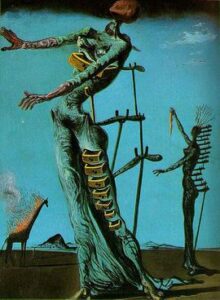
(Illustration: Salvador Dali’s ‘The Three Sphinxes of Bikini‘ found here).

Apparently, another subject placed on the news cycle back-burner, thus, out of the public eye.
Yesterday, from CNN on the NRC’s order putting southern California’s San Onofre nuclear power plant out of commission indefinitely until somebody figures out how radioactive gas is leaking from a steam generator:

The power plant has been shut down since this winter, when a small amount of radioactive gas escaped from a steam generator during a water leak.
At the time, federal regulators said there was no threat to public health, though they could not identify how much gas leaked or exactly why it had happened.
The water leak occurred in thousands of tubes that carry heated water from the reactor core through the plant’s steam generators.

“Tubes are vibrating and rubbing against adjacent tubes and against support structures inside the steam generators,” the agency noted.

In addition to driving the turbines to create electricity, the steam generators are “one of the barriers between the radioactive material in the reactor core and ultimately the external environment,” Jaczko noted.

This so-called ‘external environment‘ is home to literally millions and millions and millions of US peoples, all living not-all-that-far away from the San Onofre power plant near San Clemente — just 57.5 miles south of the very heart of Los Angles, and according to Google maps and in current driving conditions, one could get from downtown LA to the Dick Nixon library in about an hour and 10 minutes.

Oddly, I couldn’t find mention of the report on either the LA Times online front page, or the SF Chronicle.
According to the CNN story, the announcement came Friday from Gregory Jaczko, chairman of the U.S. Nuclear Regulatory Commission: “We won’t make a decision (to approve the facility’s restart) unless we’re satisfied that public health and safety will be protected,” Jaczko told reporters. “They have to demonstrate to us that they understand the causes, and … that they have a plan to address them.”
Seemingly, that would cause some mention by California’s two biggest newspapers — and including this: Anti-nuclear activists gathered Friday, not far from where Jaczko, Sen. Dianne Feinstein, D-California, and Rep. Darrell Issa, R-California, toured the power plant, to question the need for nuclear energy and raise alarms about a potential environmental catastrophe.
WTF.

Going nuclear — going atomic — is one of mankind’s all-time great worse mistakes.
There’s a humongous shit list of intentional/unintentional errors humanity has brought upon themselves, the environment, many, many other living things, but cranking out nuclear energy without really thinking about the whole, big picture might be a real biggie.
And when something happens at these nuclear plants ought to flash red to everybody, especially when a major US facility is put offline indefinitely.
Along with this from the Orange County Register in a article last week previewing RNC Chairman Jaczko’s visit, a twist in the tale:

And with nearly 20,000 tubes per reactor, the plugging of worn tubes is routine during the life of steam generators; the many tubes ensures that plugging some will not affect the generator’s performance.
But San Onofre’s steam generators — two for each reactor — are only two years old.
Such wear on the tubes so early in their life is considered “unusual,” an Edison spokeswoman said.

Operators shut down the plant Jan. 31 after a leak was discovered in those tubes, which resulted in a small release of radioactive gas: …and Edison says neither the public nor plant workers were placed at risk.
Pay no attention to that guy behind the curtain — or even the NRC, as spokesman Victor Dricks concluded two days after the San Onofre incident that radioactive gas “could have” escaped the San Onofre facility after it was shut down but added, “It would have been a very, very small, low level, which would not pose a danger to anyone.”

The Southern California Edison Webpage on San Onofre is ludicrous, creepy PR, and would make one laugh out-loud if the subject wasn’t so scary.

Meanwhile, and also announced on Friday, Japan’s government scrapped a rule requiring cattle farmers still living within 20 kilometers of the Fukushima nuclear power plant to slaughter their livestock, but they are still not allowed to sell, transport or breed the animals.
And from the SF Chronicle today: Kelp off California was contaminated with short-lived radioisotopes a month after Japan’s Fukushima Dai-ichi nuclear plant accident, a sign that the spilled radiation reached the state’s coastline, according to a new scientific study.
Fukushima just keeps on giving.

Nuclear is just nuts — and let’s not get started on the huge highly-radioactive piles of horror these plants produce — nuclear waste — a byproduct that is/will be around for a long, long time stored right near millions and millions of people, as the rant-filled discourse could take forever.

Some background on Salvador Dali’s ‘The Three Sphinxes of Bikini‘ pictured above.
The surrealist’s subject was the tragedy of the Bikini Atoll — from UNESCO:

In the wake of World War II, in a move closely related to the beginnings of the Cold War, the United States of America decided to resume nuclear testing.
They choose Bikini Atoll in the Marshall archipelago in the Pacific Ocean.
After the displacement of the local inhabitants, 23 nuclear tests were carried out from 1946 to 1958,. The cumulative force of the tests in all of the Marshall Islands was equivalent to 7,000 times that of the Hiroshima bomb.

The emergence of the atolls forming the Marshall archipelago is relatively recent.
The arrival and settlement of the Micronesian populations in the islands goes back to the 4th and 3rd millennia BCE.
Their lifestyle, which remained largely traditional over a long period, was based on fishing, and the gathering of fruit, coconut in particular.
The traditional Micronesian way of life was little affected by the visits in the 16th-18th centuries of the first European explorers such as Captain Marshall, after whom the islands were named.
The same was true of the first colonial episode, as a German protectorate at the end of the 19th century. Coconut plantations were developed.
After World War I the islands were made a Japanese mandate by the League of Nations.

The bombs changed it all.

The inhabitants of Bikini Atoll, who numbered just over one thousand, were evacuated in March 1946 to the neighbouring atoll of Rongelap.

The Bikini inhabitants were relocated several times from one atoll to another.
Those on Rongelap were authorized to return to their island in 1957, but the return proved a failure as the high degree of cesium-137 pollution made food grown on the islet hazardous.

From 1967 onwards the US authorities considered the possibility of the Bikini people returning to their atoll, and this led to work to clean up radioisotope contamination
This was carried out from 1970 onwards, backed up by an agricultural production programme.
Medical follow-up of inhabitants showed, however, high levels of human contamination as a result of consuming food produced on the atoll and water from its wells.
The atoll had therefore to be evacuated once again in 1978.

And check out a most-modern nuclear horror story at Aljazeera English on the town of Muslyumovo, not far from Russia’s southern border with Kazakhstan.
One nightmare place.

Understandably, that’s all off war products, but busting the atom is still busting the atom, and people are still flesh and blood.

« go backkeep looking »