A good, interesting interview in the days approaching our 250th anniversary celebration:
"Speaking as an early American historian who spent decades immersed in what the founding generation thought about political power — specifically about executive power — this presidency is entirely out of bounds and beyond anything the founding folk could have conceived of." — @jbf1755.bsky.social
Dr. Joanne Freeman, professor of history at Yale University, at Public Notice today — some snips:
Yeah. Speaking as an early American historian who spent decades immersed in what the founding generation thought about political power — specifically about executive power — this presidency is entirely out of bounds and beyond anything the founding folk could have conceived of. I’m not an originalist, and I don’t think every single thing they said and did in the founding era needs to be duplicated now, but this is a lot.
What they created in that moment were living documents in a living system. Our system is grounded on checks and balances — the entire system — and right now we have a Congress, with a Republican majority, that isn’t really standing up to do its duties. We have a Supreme Court that’s pretty much in line with the executive.
And then we have an executive and an administration that seem to believe they possess all of the power now. If there’s one thing that the founding folk made clear, particularly the framers of the Constitution, it was a lack of trust in a single individual having a massive amount of power.
[…]
We have a president right now who sees no limits to his power, who clearly believes he should be in power forever. He is surrounded by a lot of people who seemingly are lining up for that and agree with him. That’s fundamentally unconstitutional and also just not what our national executive is supposed to be. The degree to which this is supposed to be a position of limited power can’t be overstated.
Presidential immunity — that made my brain explode, because the idea that a president should be immune from what he’s doing in office is more in line with an authoritarian mode of government. That’s one person’s whims governing.
[…]
I didn’t spend much time thinking about norms until Trump’s first term, which caused me to realize the degree to which things we took as standard were often just agreed-upon norms that can be violated when they aren’t guardrails. There are many norms — like not having a UFC fight on the grounds of the White House or using the walls of the White House to insult predecessors — where violating them isn’t inherently illegal or unconstitutional, but is against the spirit of a free and small-d democratic government.
Some shit:
End game, or not, yet once again here we are …
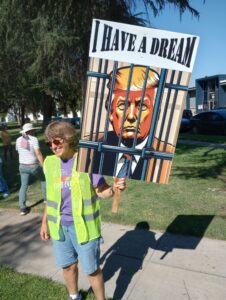 (Illustration out front is a photo from our local ‘No Kings’ rally last October).