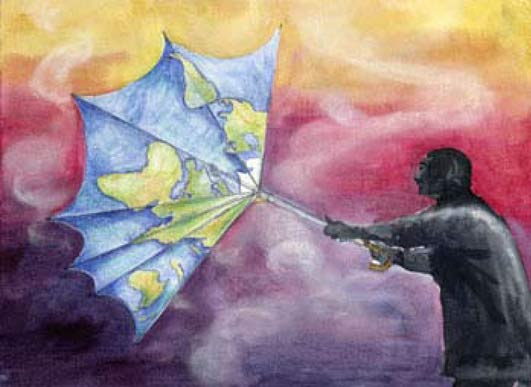
Tea Cup Turbulence

Filed Under Cloud gazing, Environment, Finance, Weather | Leave a Comment

Climate change is corrupting Bangladesh tea — the low-lying nation has a great tea growing industry, but the warming temperatures with less rain not only stumps growth, but can alter the flavor.
From Aljazeera English and a tea harvester:

“There is less clouds in the sky than before. Too much sun, which isn’t good for the plants, a lot less rain. How do you expect the plants to grow?”

Hundreds of thousands of people depend on the tea sector, but if climate change is responsible for the hotter weather being experienced now, it is just a matter of time before these plantations perhaps disappear altogether.

(Illustration found here).

Although Bangladesh tea picture is rosy right now — The average price of Bangladeshi tea rose 2.1 percent to 159.28 taka ($1.96) per kg from the previous sale, said an official at the National Brokers Limited, the country’s largest tea broking firm — the future isn’t so bright.

A warming world will make dust of leaves and plants.
Via Climate Progress:

The results of studies that try to quantify the effects of climate change on biodiversity loss — which include damage to the micro scale level of subspecies and genetic variation — are perhaps most shocking.
When, however, you focus on the response to climate change at the macro level, the ecosystem level, you get a better understanding of what is one of the major drivers of that biodiversity loss: forced migrations.
And even here, the numbers may be larger than one would expect, as a new assessment by NASA and Caltech published in the journal Climatic Change shows that by 2100 some 40 percent of “major ecological community types” — that is biomes like forest, grassland, tundra — will have switched to a different such state.
According to the same study most of the land on Earth that is not currently desert or under an icecap will undergo at least a 30 percent change in vegetation cover.
Based on IPCC temperature projections for 2100 [which are probably on the conservative side] of 2-4 degrees Celsius warming scientists of NASA’s Jet Propulsion Laboratory and the California Institute of Technology ran special computer models to calculate the most probable ecosystem responses across the planet.
This average temperature rise is of similar magnitude to the warming that occurred between the Last Glacial Maximum and the onset of the (milder) Holocene — with the big exception that the current warming is happening about 100 times faster — and for ecology that makes a huge difference, the authors stress.

Acceleration of the process is the key.
And not only has the world kicked the climate change can-of-worms on down the dusty road (via 2020), but has failed to even fund the ‘normal’ disasters, making the planet “dangerously unprepared” for future crises.

Earlier this month, the American Geophysical Union at its annual meeting in San Francisco painted a cruel picture of the can of worms.
The problem is bigger, faster and shitty-er.
Via Climate Science:

Four years ago scientists thought the Arctic would not be ice-free in summer before 2100.
Two years ago, the estimate was 2060.
This year, scientists say the ice could be gone by 2030, possibly even 2020.
As Arctic ice melts and temperatures rise, vast stores of methane frozen under the Arctic Ocean are starting to thaw and vent to the atmosphere.
Methane is a potent greenhouse gas, 20 to 56 times as powerful as carbon dioxide.
Researchers had seen small plumes.
But a recent survey showed, to their shock, large areas of the ocean pocked with continuous, powerful plumes stretching a half-mile or more across.
In the Andes, conventional wisdom held that residents had 20 years to 40 years to find a replacement for the dwindling glaciers serving as key dry-season water reservoirs.
That time is up, reported Michel Baraër, a researcher at McGill University in Montreal.
The era of “peak water” is past, he said, and hundreds of thousands of people living downstream face an immediate future of diminished and more variable flows.

“The planet is going through incredible change,” said Jonathan Foley, director of the University of Minnesota’s Institute on the Environment.
“Through rapid uses of the environment, we are pushing our planet in extreme ways.”

“We are now on a very different planet than anyone has ever seen before,” Foley said.
“All of our predictions are going to be wrong.
We are going to be very, very surprised.”

Of course, not everybody — some can see the future in the tea leaves.

Good-bye Tomorrow

Filed Under Cloud gazing, Environment, Lying, Weather | Leave a Comment

Climate change ain’t for bullshitters.

And no crap talk — President Obama’s video visit to the UN climate talks  in Durban, South Africa, citing the late Nobel peace prize winner and Kenyan environmentalist Wangari Maathai: “Here in Durban, we can carry on her work, to … grow our economies in a way that’s sustainable and that addresses climate change. In this you have the partnership of the United States. Delegates must remember her call in which she said: ‘We must not tire. We must not give up.’”

One hundred percent, pure, prime-cut US bullshit.

Deceitful words like from this dangerous asshole: “We don’t kill our people… no government in the world kills its people, unless it’s led by a crazy person,” Assad said…”There was no command to kill or be brutal.”

Whom to believe — our lying eyes or a couple of bullshitters?

(Illustration found here).

One can twist eyebrows at a comparison between Obama and Syrian dictator Bashar al-Assad, “a crazy person,” who’s trying to hold power by killing and torturing his fellow citizens, and in a literal sense there is no resemblance, but Obama’s bullshit will affect/effect way-way-more people and cause way-way-more harm.
Assad is just pushing back his own judgment day, he’ll eventually be dragged out of a drainage ditch somewhere in Syria and his long neck stretched even further.

Playing funny with climate change just ain’t that funny.
From Scientific American on how these meetings have failed to keep up with the real science of what’s happening to this planet:

Most climate scientists, however, would beg to differ.
The latest science suggests that international negotiations are proceeding far too slowly to have any significant impact on global warming and may well dawdle too long to prevent catastrophic climate change.
To meet the international target of restraining the warming of global average temperatures to just 2 degrees Celsius will require greenhouse gas emissions of just 44 billion metric tons in 2020.
And even that amount might not be enough: James Hansen of NASA said this week at the American Geophysical Union meeting in San Francisco that the 2 degrees C target “is a prescription for disaster.”
What’s happening is that research keeps finding new trouble signs.
Thanks to a rebound in global economic activity, 2010 saw the biggest single year increase in emissions ever—5.9 percent higher to be exact, according to the World Meteorological Organization.
Another analysis, published December 4 in Nature Geoscience, found that nearly all of the nearly 1 degree C warming observed over the last century or so could be attributed to human emissions of greenhouse gases.
The U.K. Met Office stated in a December 5 report that as many as 49 million people could be at risk from increased coastal flooding because of climate change and many others from a drop in the production of staple food crops.
The U.N. Intergovernmental Panel on Climate Change (IPCC) argues that emissions must be halved by mid-century to have any hope of restraining warming to 2 degrees C.
“After four rounds of IPCC reports, is the science not clear enough?” asked Jato Sillah, Gambia’s minister of forestry and environment during a speech on December 6.

Apparently, it’s not clear enough for American interests — the US wants to kick the horrible can of worms far, far on down the road.
Jamie Henn at Grist:

Instead, the pace of negotiations has been set by the one country the rest of the world should be turning their back on: the United States.
The U.S. never signed the Kyoto Protocol, the only legally binding international agreement designed to reduce emissions, but it is allowed to take part in the negotiations in a separate track dedicated to securing a long-term climate agreement.
After President Obama’s election, the international community had high hopes the new administration would bring a new sense of ambition and commitment to talks.
Instead, the only thing the U.S. brought to the table was a wrecking ball.
Rather than standing out of the way and letting the rest of the world get on with setting up an international architecture to facilitate cutting emissions, stopping deforestation, and investing in renewable energy, the U.S. has spent the years since Copenhagen attempting to systemically dismantle the U.N. process.
Highest on the U.S. hit list is the Kyoto Protocol, an imperfect treaty (thanks in large part to U.S. recalcitrance), but currently the best instrument in the global climate toolbox.
Next on the list is the very idea of legally binding commitments — the U.S. would prefer a “pledge and review” world where countries make their own voluntary commitments and then report out on what they’ve decided.
Here in Durban, however, the U.S. has taken on an even more insidious role by pushing a proposal that the international community adopt a “mandate” to negotiate a new climate treaty that will take effect in — wait for it — 2020.
This isn’t just a delay, it’s a death sentence.
Scientists have stated over and over that in order to avoid catastrophic climate change, emissions must peak by 2015 or 2020 at the absolute latest.

I don’t like bad weather — abnormal bad weather scares the shit out of me.
And climate change ain’t just about the weather — food, water, sea-level rise, drought, extinction — nothing heavy.
And one must not forget that tomorrow is just today yesterday.

‘Danger, Will Robinson’ — It’s The GOP!

Filed Under Bullshit, Environment, Health, Weather | Leave a Comment

One cannot imagine the uselessness of combating anything of importance with those elected so-called leaders of the near-rudderless US of A — the failure of the “super committee” is the latest example of why mankind just might be freakin’ doomed.
If these assholes can’t agree on finances, how can they reach an accord on the most-worrisome problem facing the planet — climate change.

The glitch in the ‘super committee?
Think Progress answers with the obvious: Time and time again, the only thing preventing an agreement on long-term deficit reduction has been the Republicans’ absolute refusal to consider any tax increases on high-income households as part of the solution.
(Illustration found here).

Republicans don’t understand the word ‘solution’ — a much-glaring case in point was a Congressional climate briefing last week in which not only were there zero GOPers in attendance, but the whole affair was smaller than a blink on the all-news, all-the-time media.
The Natural Resources Committee held a briefing called, “Undeniable Data: The Latest Research on Global Temperature and Climate Science,” chaired by two Democrats, Ed Markey and Henry Waxman, with three top climate scientists testifying, Dr. Ben Santer, an expert on climate change attribution; Dr. Bill Chameides, vice chair of the National Academy of Sciences’ Committee on America’s Climate Choices; and a former chief climate-change denier/skeptic, Dr. Richard Muller of the Berkeley Earth Surface Temperature (BEST) project, finally now a believer.
Via Skeptical Science:

Rep. Waxman also noted that the Republican-controlled House has voted 21 times to block actions to address climate change, including a vote to deny that “climate change is occurring, is caused largely by human activities and poses significant risks for public health and welfare.”

The take-home message from each presentation is:
Muller: The planet is undeniably warming. Muller is personally not convinced how much of that warming is due to humans, but believes the remaining uncertainty is not sufficient to prevent us from taking serious action to reduce greenhouse gas emissions.
Santer: The scientific evidence clearly indicates that the observed global warming is predominantly caused by humans.
Chameides: The prudent path forward involves a diversified risk management approach, which must involve a comprehensive federal policy to reduce greenhouse gas emissions.
Overall it was a very interesting and informative briefing.
Unfortunately, the fact that it was attended by zero Republican congressmen suggests that contrary to the hearing subtitle, it will not be the end of climate skepticism, but perhaps it at least represents a small step in the right direction.
Maybe Congressional Republicans will find some time to listen to climate scientists when they’re finished classifying pizza as a vegetable.

Skeptical Science titled its post, “Congressional Climate Briefing – The End of Climate Skepticism?
That question mark could also read, Republican.

All this GOP bullshit comes on the heels of a couple of bad reports cards on our environment.
Yesterday, another snapshot of reality:

The amount of greenhouse gases in the atmosphere reached a new high in 2010 since pre-industrial time and the rate of increase has accelerated, according to the World Meteorological Organization’s Greenhouse Gas Bulletin.
It focussed special attention on rising nitrous oxide concentrations.
Between 1990 and 2010, according to the report, there was a 29 percent increase in radiative forcing — the warming effect on our climate system — from greenhouse gases.
Carbon dioxide accounted for 80 percent of this increase.

The atmospheric burden of nitrous oxide in 2010 was 323.2 parts per billion — 20 percent higher than in the pre-industrial era.
It has grown at an average of about 0.75 parts per billion over the past ten years, mainly as a result of the use of nitrogen containing fertilizers, including manure, which has profoundly affected the global nitrogen cycle.
Its impact on climate, over a 100 year period, is 298 times greater than equal emissions of carbon dioxide.
It also plays an important role in the destruction of the stratospheric ozone layer which protects us from the harmful ultraviolet rays of the sun.

And if that isn’t bad enough: The US Dept. of Energy earlier this month said in 2010, The global output of heat-trapping carbon dioxide jumped by the biggest amount on record, the U.S. Department of Energy calculated, a sign of how feeble the world’s efforts are at slowing man-made global warming.
(Great h/t to Climate Progress).

Danger indeed, Will Robinson, but guys,  Zachary Smith should have been history long before now.

Warming Heat

Filed Under Cloud gazing, Environment, Weather | Leave a Comment

Another nasty package on the highly-movable climate-change-train as a new study (once again) signals earth is moving beyond heat — revealing the crazy Russian heat wave last year most-likely wouldn’t have happened without global warming.
Abstract from the research posted at PNAS:

We estimate that climatic warming has increased the number of new global-mean temperature records expected in the last decade from 0.1 to 2.8.
For July temperature in Moscow, we estimate that the local warming trend has increased the number of records expected in the past decade fivefold, which implies an approximate 80 percent probability that the 2010 July heat record would not have occurred without climate warming.

(Illustration found here).

Joe Romm at Climate Progress on the study: Again, this extreme event ended Russian grain exports for year. So the increase in extremes very much threatens food security if we don’t act soon to reverse emissions trends.

In other words, gird thy loins, or learn how to re-eat foodstuffs.

Romm also notes the study from PNAS (Proceedings of the National Academy of Sciences of the United States of America) is a “bombshell” because NOAA did a flawed analysis just a few months ago that found no connection between global warming and the record-smashing (heat).
Wiggle room is shrinking for deniers.

And another anti-denial nail was driven home this past week — the Berkeley Earth Surface Temperature project, which was supposed to slash holes into the very heart of climate change, released a report ‘confirming‘ the bad news the earth is indeed burning alive.
From former ‘skeptic‘ Richard Muller, the chair of the Berkeley study, in the Wall Street Journal:

We discovered that about one-third of the world’s temperature stations have recorded cooling temperatures, and about two-thirds have recorded warming.
The two-to-one ratio reflects global warming.
The changes at the locations that showed warming were typically between 1-2ºC, much greater than the IPCC’s average of 0.64ºC.

When we began our study, we felt that skeptics had raised legitimate issues, and we didn’t know what we’d find.
Our results turned out to be close to those published by prior groups.
We think that means that those groups had truly been very careful in their work, despite their inability to convince some skeptics of that.
They managed to avoid bias in their data selection, homogenization and other corrections.
Global warming is real.
Perhaps our results will help cool this portion of the climate debate.
How much of the warming is due to humans and what will be the likely effects?
We made no independent assessment of that.

Just watch the weather reports, Richard.
Despite Muller and his study, some people are still hard-headed wrong — read a good view of fallout from the Berkeley study on the hardcore denial crowd at DeSmogBlog, and follow the links.

Paul Krugman, in his New York Times column last week, took to task another study, this one from the American Petroleum Institute (and one can guess its point of view), which is the core of the GOP’s economic proposals — pollution makes for more jobs.
Republicans, however, don’t even understand their own shit.
Money bits:

But does this oil-industry-backed study actually make a serious case for weaker environmental protection as a job-creation strategy?
No.

Moreover, even if you take the study’s claims at face value, it offers little reason to believe that dirtier air and water can solve our current employment crisis.
All the big numbers in the report are projections for late this decade.
The report predicts fewer than 200,000 jobs next year, and fewer than 700,000 even by 2015.
You might want to compare these numbers with a couple of other numbers: the 14 million Americans currently unemployed, and the one million to two million jobs that independent estimates suggest the Obama plan would create, not in the distant future, but in 2012.
More pollution, then, isn’t the route to full employment.
But is there a longer-term economic case for less environmental protection?
No.
Serious economic analysis actually says that we need more protection, not less.

As the study’s authors say, finding that an industry inflicts large environmental damage compared with its apparent economic return doesn’t necessarily mean that the industry should be shut down.
What it means, instead, is that “the regulated levels of emissions from the industry are too high.”
That is, environmental regulations aren’t strict enough.
Republicans, of course, have strong incentives to claim otherwise: the big value-destroying industries are concentrated in the energy and natural resources sector, which overwhelmingly donates to the G.O.P.
But the reality is that more pollution wouldn’t solve our jobs problem.
All it would do is make us poorer and sicker.

And the planet gets warmer and warmer while ignorant dickheads fiddle.

In the Gut — Breadbasket Could Be Toast

Filed Under Cloud gazing, Economy, Environment, Weather | Leave a Comment

Even as President Obama attempts to throw out some kind of jobs plan tonight — the hornet’s nest in the US economy right now — one problem that’s quickly creeping worse strikes at the heart of life — food.
The UN Food and Agriculture Organization reports global food prices remain high — especially wheat, rice and corn, the foundation for eating — and with weird, calamitous weather the norm, lack of availability will drive prices much higher.

And amongst those GOP nit-twits debating bullshit topics Wednesday night, one aspect Republicans hate is the very mention of climate change, the very things that keep foodstuffs so high — even the US is feeling the impact in its gut — the Midwest’s so-called breadbasket of the world.

(Illustration found here).

The US has indeed been the last half century the world’s breadbasket — this year, this country planted 2,839,000 acres in oats, 3,018,000 acres of rice, 16,792,000 acres of wheat, and 92,178,000 acres of corn (amongst other major crops like soybeans, hay, barley, etc.), the vital substances for any foodstuff menu.
The US accounts for 50 percent of the world’s corn and 30 percent of wheat.
Corn is the biggest US cash crop, valued at $66.7 billion in 2010, followed by soybeans at $38.9 billion, USDA data show, and exported 46,360 metric tons of that corn so far this year — and corn production has declined: National Ag Statistics reported a U.S. average corn yield below trend value due to adverse planting and growing conditions in many parts of the country and extremely high temperatures in July…
And it’s going to get worse.

Changes in climate is already taking place and it has/will have a major impact on the breadbasket.
From Reuters:

Some scientists and agronomists are becoming increasingly concerned about the real effects they see now on growing conditions in the Midwest, the vast black-soiled region long the core region of the U.S. agricultural miracle.
They also say that not only skeptical farmers but also government authorities are trying to quietly adapt, from equipment to planting to research.
“We don’t have a long-term reserve. We have a global food supply of about 2 or 3 weeks,” said Eugene Takle, Professor of Agricultural Meteorology and Director of the Climate Science Program at Iowa State University.
“We’ve become insensitive to climate — with air conditioning, irrigation and better practices,” he said. “Well, I think we need to rethink that.
Just how vulnerable are we?”
Takle and others say the future is now.

“It’s not the long-term climate trends,” Takle says,
“It’s the variability.
It’s the extreme events that have brought the vulnerability of agriculture to climate into the forefront. We think about, and wring our hands for awhile.”

In June 2009, the science academies of the G8 countries, plus Brazil, China, India, Mexico, and South Africa, demanded action to address global climate change that “is happening even faster than previously estimated.”
Takle said Midwest farmers are already adapting.
“Farmers say they don’t believe in climate change, but you look at how they spend money and are adapting,” he said.

And from the US Global Change Research Program:

Agriculture covers 70 percent of the Great Plains.
As temperatures continue to rise, the optimal zones for growing certain crops will shift.
Pests will spread northward and milder winters and earlier springs will encourage greater numbers and earlier emergence of insects.
Projected increases in precipitation are unlikely to be sufficient to offset decreasing soil moisture and water availability due to rising temperatures and aquifer depletion.

Climate change is likely to combine with other human-induced stresses to further increase the vulnerability of ecosystems to pests, invasive species, and loss of native species.
Breeding patterns, water and food supply, and habitat availability will all be affected by climate change. Grassland and plains birds, already stressed by habitat fragmentation, could experience significant shifts and reductions in their ranges.

Can a hoax pull off this shit?

keep looking »