Asleep at the Pump

Filed Under Economy, Energy, Environment, Technology | Leave a Comment

After a visit to the laundromat this morning, I put another $20 worth of gas in the old, problem-plagued Jeep, wincing (both the Jeep and I) at a pump price of $3.99 a gallon for regular — up more than a dime since the last time.

And apparently based on the so-called favorable employment report released Friday, U.S. sweet crude increased by $1.48 to end the week at $97.84 per barrel, while Brent picked up $2.51 to finish at $114.58 per barrel.
Gas-pump prices appear erratic, depending where ye be: Statewide average in California is $3.73 a gallon for regular, up 3.7 cents in a week, but meanwhile, a good friend of mine residing less than two hours south of me recently paid $4.19 a gallon — Sup with that?

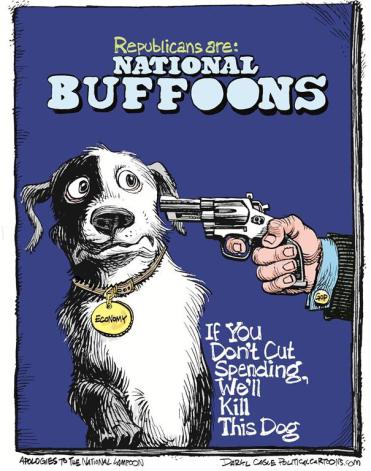
(Illustration found here).

Maybe we should take the plunge already and go Eurozone — $10-a-gallon gas would force stiff-necked US peoples to alter lifestyles and move on before the whole thing becomes reality.
New fuel for old vehicles — there’s about 240.5 million cars and light trucks cruising US highways and the average age of those vehicles rose to 10.8 years last year from 10.4 in the year before, due mainly to bad times in Detroit and the economy.
Apparently from indications beyond a recession, US peoples have been easing off the private vehicle for awhile now.
Via AlterNet  two years ago:

Among the trends that are keeping sales well below the annual figure of 15-17 million that prevailed from 1994 through 2007 are market saturation, ongoing urbanization, economic uncertainty, oil insecurity, rising gasoline prices, frustration with traffic congestion, mounting concerns about climate change, and a declining interest in cars among young people.
Market saturation may be the dominant contributor to the peaking of the U.S. fleet.
The United States now has 246 million registered motor vehicles and 209 million licensed drivers — nearly 5 vehicles for every 4 drivers.

Kids and cars:

Perhaps the most fundamental social trend affecting the future of the automobile is the declining interest in cars among young people.
For those who grew up a half-century ago in a country that was still heavily rural, getting a driver’s license and a car or a pickup was a rite of passage.
Getting other teenagers into a car and driving around was a popular pastime.
In contrast, many of today’s young people living in a more urban society learn to live without cars.
They socialize on the Internet and on smart phones, not in cars.
Many do not even bother to get a driver’s license.
This helps explain why, despite the largest U.S. teenage population ever, the number of teenagers with licenses, which peaked at 12 million in 1978, is now under 10 million.
If this trend continues, the number of potential young car-buyers will continue to decline.

Plus these kids now are also faced with an incredible financial burden, not only with a humongous student-loan debt, but a bleak employment picture (despite Friday’s numbers) — unless one is an oil/gas person (corporations are people).

Maybe a bit of inequality right there: Exxon’s $41.1 billion in 2011 profit translates into nearly $5 million in profit every hour, or more than $1,300 every second. The annual profit comes near the record revenues of $46.23 billion in 2008…Between 2008-2010, Exxon Mobil registered an average 17.6 percent federal effective corporate tax rate, while the average American paid a higher rate of 20.4 percent.

Maybe venture into the ugly-oddness of fuel:

Gasoline prices are higher at the beginning of 2012 than at the beginning of any previous year ever — even at the beginning of 2008, a year when the national average for a gallon of regular unleaded gasoline reached a record $4.114 on July 7.
In its Daily Fuel Gauge Report, AAA Texas noted Friday a national average of $3.467 for a gallon of regular unleaded gasoline — up from $3.455 a day ago, $3.389 a week ago, $3.288 a month ago and $3.116 a year ago.
“We’re seeing the highest gasoline prices that we’ve seen,” Sarah Schimmer of AAA Texas said Friday.
“2011 was a record year, and in 2012 we’re definitely seeing higher prices.”

And all this for mobility, not only just for driving my Jeep around town, but oil/gas framed within the way-big picture of how the existence of an entire civilization depends on the black, bubbly shit — no way yesteryear can continue into the nowadays.
In reality, peak oil is actually the end of easy oil, low prices at the pump and so forth, and this peak supposedly occurred worldwide in about 2005 — so we’re already on the downside.
One interesting look at future possibilities comes from “Fleeing Vesuvius: Overcoming the Risks of Economic and Environmental Collapse,” a collection of essays from economists, environmental scientists, a couple of architects and even a corporate lawyer on the premise of how close we are to being totally f*cked.
From a review by Stuart Jeanne Bramhall of Fleeing Vesuvius and posted Friday at DissidentVoice:

The title refers to the volcano that destroyed Pompeii in 79 AD, specifically the large number of residents who failed to save themselves, despite weeks of earthquakes, gaseous clouds and other obvious signs that an eruption was imminent.
For more than a decade, a growing body of evidence suggests that the planet is on the verge of economic and ecological collapse.
Yet the vast majority of us do absolutely nothing to prepare for the stark conditions ahead.

All (the essay writers) are in basic agreement around the book’s central premise: the industrialized world needs to urgently downsize its energy use, both to stave off catastrophic climate change and to conserve dwindling fossil fuels.
In his Introduction, “Where We Went Wrong,” the late Irish economist Richard Douthwaite points out that one barrel of oil provides the equivalent labor of a man working forty hours a week for twelve years.
He goes on to stress that before the advent of cheap fossil fuels, capitalism was impossible — an economy relying on human labor and animal power is too inefficient to support it.
By definition capitalism depends on capital accumulation, the production of an economic surplus that can be reinvested in new capital (property and machines) to expand production even further.
Producing a surplus of this size only became possible because of the vast amount of cheap (practically free) work performed by fossil fuel energy.

And Ms Bramhall also reveals a brightness from the essays, not all doom-n-gloom: The last five sections of the book focus on solutions, with inspiring examples of new approaches to land use, agriculture and industrial design from individuals, groups and communities who have begun the transition to a less energy-intensive lifestyle.
Inspiration needs to have already been popped — too much pie-in-the-sky without actual political reality.
One updated  sample chapter of Fleeing Vesuvius can be found at The Oil Drum.
And another review of the essay collection can be found here.

A major snag in the optimism — the above-mentioned political reality.
So says Kumi Naidoo, head of the environmental group Greenpeace, who spoke Friday at the big-wig, pow-wow Munich Security Conference, and chimed a loud alarm.
Via Raw Story:

“The moment of history we are in can be described as a boiling point or a perfect storm,” he told the assembled gathering of world leaders, ministers, top brass and defence policy experts at the annual Munich gathering.
“We are seeing a convergence of multiple crises happening at the same time. A food crisis, climate crisis, poverty crisis … and then of course the financial crisis and a demographic crisis and a global governance democratic crisis,” he added.
“The bottom line is that too many of our leaders … are sleepwalking us into a crisis of epic proportion,” he claimed.

One of those doing the sleepwalking is US Secretary of State Hillary Clinton, who’s also in Munich, Germany, this weekend for the conference, but her schedule has no room for end-of-life-as-we-know-it antics fostered by environmental activists — Clinton will most-likely reminisce about “…what a key partner Europe is in the global security, economic, democracy promotion agenda that we have.”

Just wake ‘em later.

Potable Wine

Filed Under Cloud gazing | Leave a Comment

In an era of supposed enlightenment, marijuana still remains on the fringe — Dude, that needs to change.

Newt Gingrich, however, does appear even worse after a couple of tokes — some changes require way more.

Pot is the weaker sister — the big headline in this story was marijuana, but alas…

A Rhode Island lawmaker is due in court following his second arrest on marijuana possession charges.

Police say they found marijuana and a smoking pipe in Watson’s vehicle, along with an opened beer can and two unopened beer bottles.

Smoke gets blamed for shit that just ain’t so.

(Illustration found here).

Living in the very midst of the pot-growing center of the universe makes a discussion about marijuana as dumb as a stump — pack that in your pipe and draw hard.
The discovery of weed in the mid-1970s was the second greatest single event in my life, changing attitudes, outlooks and how life actually works — no, this ain’t Kansas no more.
Marijuana is not the evil, the bad guys are those who not only don’t smoke, but hate those who do and wish horrible things upon smokers are the culprit — marijuana needs legalization.
And a good chunk of US peoples feel the same.
From CBS:

President Obama’s live, online chat slated for Monday afternoon is intended to focus on issues raised during last week’s State of the Union address — but his online audience seems to be much more interested in marijuana policy.

Sorting the questions by popularity reveals that 18 of the 20 most popular questions, according to YouTube, have something to do with marijuana policy, including the legalization of marijuana use, the cost of the war on drugs and other related issues.
Questions about marijuana policy have dominated multiple online engagement efforts from the Obama White House.
In fact, the second-most popular question for today’s “hangout” comes from a retired police officer with the group Law Enforcement Against Prohibition (LEAP) — just as it did in Mr. Obama’s 2011 YouTube chat.

And from Slate: In 1969, 12 percent of Americans thought pot should be legal. That percentage grew to the mid-20s by the late 1970s, passed 30 percent in 2000, and hit 40 percent in 2009, according to Gallup. A surprising October poll showed support at 50 percent, with just 46 percent against.
Lawmakers and other nefarious types are not paying attention, however.

Here in California, a ballot-box vote is on tap this November.
And about time:

A recent poll reveals that California voters, by a 62% to 35% margin, with 3% unsure, support a ballot initiative to regulate marijuana like wine.

Voters in California will have an opportunity to take that new approach this November with the Regulate Marijuana Like Wine Act of 2012 (RMLW), which will allow the state to regulate and tax marijuana and hemp.
The California Attorney General has projected “savings of potentially several tens of millions of dollars annually to state and local governments of the costs of incarcerating and supervising certain marijuana offenders,” as well as potentially generating “hundreds of millions of dollars in net additional tax revenues related to the production and sale of marijuana products.”

Law enforcement buys it, too.
And why don’t you?

Tomorrow Is Not Just Another Day

Filed Under Cloud gazing, Environment, Everything | Leave a Comment

Monday morning, and getting close to the end of another month — time flies when all kinds of shit are hitting the fan.

Including this horror show in Florida — and I don’t mean  the upcoming GOP primary:

“As it was happening on the northbound side, it was happening on the southbound side as well,” he said.
“There was nowhere to go. It was just cars hitting cars and cars.”
He called the scene “horrendous.”
“Everybody was crying,” he said. “You still can’t see anything.”
Some motorists were stuck in their vehicles, he said, calling it “mass chaos.”

Mankind should take another look at how we move ourselves around on this earth.

(Illustration found here).

Even as more than 300 people have been arrested in Oakland in an Occupy throw-down, the problem of inequality is been seen as worldwide, an in vestment in a trouble future and if ignored problems will keep popping up everywhere.

A UN report — “Resilient People, Resilient Planet: A Future Worth Choosing” — displays the growing trouble of cash flow.
From the BBC:

Ms Halonen (co-chair of the report, Finnish President Tarja Halonen) emphasised the theme of equality that runs through the report, in terms of gender and redressing the burgeoning gap between people on high and low incomes.
“Eradication of poverty and improving equity must remain priorities for the world community,” she said.

“We undertook this report during a period of global volatility and uncertainty,” it says.
“Economies are teetering. Inequality is growing. And global temperatures continue to rise.
“We are testing the capacity of the planet to sustain us.”
To turn this around, it says: “We need to change dramatically, beginning with how we think about our relationship to each other, to future generations, and to the ecosystems that support us.”

Even as the US turns skeptic, just north of us is calling bogus:

Some of Prime Minister Stephen Harper’s newly-appointed senators are emerging as global-warming skeptics in the wake of aggressive government positions to abandon the Kyoto Protocol, slam environmentalists and downplay potential damage caused by Canadian oil and gas exploration.
“I felt like it is kind of an insult to be a denier for a long time,” said Sen. Bert Brown, last month at a parliamentary committee studying energy policies.
“It feels pretty good this morning.”

Laugh at the tomorrow, cry for the future.

Pump Sump

Filed Under Cloud gazing, Energy, Environment | Leave a Comment

Yesterday after work, I put another $20 worth of gas in the old Jeep Comanche, now back up at $3.89 a gallon for regular — up three cents since the last time we visited the pump, less than a week ago.
And in line with the rest of the US, pump prices rose nearly 3.5 cents a gallon the last few days to a national average of $3.39 a gallon — in California a gallon now is $3.71, up 1.4 cents in a week.
The prices are nearly 30 cents higher than the same time last year.

A penny here, a penny there and soon you’ve have a pile of some real money.

(Illustration found here).

Crude is still gushing upward.
From liveoilprices: In London, Brent crude oil futures for March 2012 delivery was trading at $111.22 a barrel, 15.30 GMT today on the ICE Futures Exchange.
Meanwhile, WTI: US Light crude oil futures for March 2012 delivery was trading at $99.67 a barrel, 15.06 GMT today in trading on the NYMEX. The US oil contract is up 1.2 percent over this mornings opening price of $98 a barrel.

The shit with Iran is the bad bet at the pump.
The International Monetary Fund warns the planet:

The International Monetary Fund warned on Wednesday that global crude prices could rise as much as 30 percent if Iran halts oil exports as a result of U.S. and European Union sanctions.
If Iran halts exports to countries without offsets from other sources it would likely trigger an “initial” oil price jump of 20 to 30 percent, or about $20 to $30 a barrel, the IMF said in its first public comment on a possible Iranian oil supply disruption.
The IMF highlighted the risks of rising tensions over Iran sanctions in a note on Wednesday sent to deputies from G20 countries who met in Mexico City last week.
The price impact caused by a cut in Iranian exports could be exacerbated by below average oil stocks in many countries, the result of tight oil market conditions through much of last year, the IMF said.

And in this the old ‘peak oil’ ugly raises its head.
Via the New York Times:

In an opinion piece (paywall) released on Wednesday by the journal Nature, James Murray of the University of Washington and David King of the University of Oxford point out that global oil production appeared to hit a cap of about 75 million barrels a day in 2005.
Since then, they note, small supply bumps have caused big price gyrations, yet even when prices spike above $100 a barrel, supply appears incapable of rising to meet the demand.
The professors make only a glancing mention of the term “peak oil,” a widely promoted and widely attacked concept, but their argument resembles some of the less feverish versions of the peak oil case.
They essentially argue that oil supply now represents a large strategic risk to global economic growth, and that smart governments ought to be developing comprehensive plans and pushing hard to move their citizens into more efficient cars, onto public transit and so forth — a greener energy path that would also be good for the climate.

Even with all this mess at the gas pumps, there’s an underlying bullshit irony to it all.
Oil companies know the future is coming — via TreeHugger:

Utilities, the oil and gas industry, agricultural companies and insurers are building assumptions about rising temperatures and extreme weather events into their scenario planning.
This is what’s being called climate adaptation or climate preparedness.
The payoff from investing in adaptation could be substantial.
In 2011, insured losses in the U.S. from natural catastrophes, including tornadoes, floods and hurricanes, topped $105 billion, breaking the record of $101 billion set in 2005, the year of Hurricane Katrina, according to Munich Re, the world’s largest reinsurance firm.
Some of those losses had nothing to do with climate change, but others did.

Pump it down and dirty.

Action Jackson

Filed Under Cloud gazing, Politics | Leave a Comment

Using Osama bin Laden as a kind of verbal bookends, President Obama jumped on reality with a touch of a man-up pose in his state-of-the-union speech last night, calling on the US to “restore an economy where everyone gets a fair shot, everyone does their fair share, and everyone plays by the same set of rules.”
The 65-minute speech was called “feisty,” and “combative,” and in true political reality, was indeed a well-heeded campaign start-up — Obama’s leaves this morning to start the November ball a-rolling.

(Illustration found here).

Obama even had the flag carried by the US Navy SEAL team that assassinated Osama last year: “Some may be Democrats. Some may be Republicans. But that doesn’t matter. Just like it didn’t matter that day in the Situation room…All that mattered that day was the mission. No-one thought about politics…”

And he pounded it home:

“Each time I look at that flag, I’m reminded that our destiny is stitched together like those fifty stars and those thirteen stripes.
No-one built this country on their own,” Obama said.
“This nation is great because we built it together.
This nation is great because we worked as a team.
This nation is great because we get each others’ backs.
And if we hold fast to that truth, in this moment of trial, there is no challenge too great, no mission too hard.”

In this he laid the groundwork for the next eleven months — the real man-up ruler of the US can only be the guy that got Osama bin Laden, and it will surely not work if anyone else takes the reins of power, so vote for me!
And boxed in between the warmongering, Obama slapped at income inequality and the Republicans who have produced the situation — the president proposed big shifts with the US tax system, like for instance, a minimum 30 per cent effective rate on millionaires.
Which prompted Mitch Daniels in response to whine: “No feature of the Obama presidency has been sadder than its constant efforts to divide us, to curry favour with some Americans by castigating others,” Daniels said, according to excerpts of his speech.
In other words — leave the rich alone.

And this tweet via Aljazeera English: “RT @theonlyadult: Osama Bin Laden is dead and General Motors is alive. #obama2012 #sotu”

And as if on cue, early this morning U.S. Navy SEALs popped into Somalia to grab two kidnapped aid workers — an American and a Dane — in a daring helicopter raid reminiscent of the Osama attack.

Before news broke of the rescue, Obama told Defense Secretary Leon Panetta, “Leon, good job tonight. Good job tonight,” at the State of the Union address.

Election 2012 is gonna be a dandy, action-packed pile of hollerin’ bullshit.

keep looking »