Sweet in the Chaos of Sour
Filed Under Cloud gazing | Leave a Comment
In the daily grind — it’s early AM in California again — there’s some notice of just how sweet little things can be, something to slow the sliver of wood-fragment-splinter of bad shit covering the news of the world.
I’ve sent this to a couple of my children — one posted it on her Facebook page.
Watch and weep with joy here.
And for another one, even more sweet, yet with a touch of hilarious, check this out.
Have a WTF day.
Vats of Fire And Rain — ‘Extreme Events’
Filed Under Cloud gazing, Environment, Weather | 1 Comment
The future cooks while humanity cries through the looking glass:
As the climate warms, we expect heat waves to become more frequent (Ganguly et al., 2009).
Now there is still considerable uncertainty on where the heat waves will occur, that seems to depend on the climate model used.
However, the physics of heat waves do not change.
Heat waves in climate simulations are still associated with upper-level ridges (Meehl and Tebauldi, 2004).
This suggests that we will likely see more heat waves like the Muscovite heat wave of 2010 in the future.

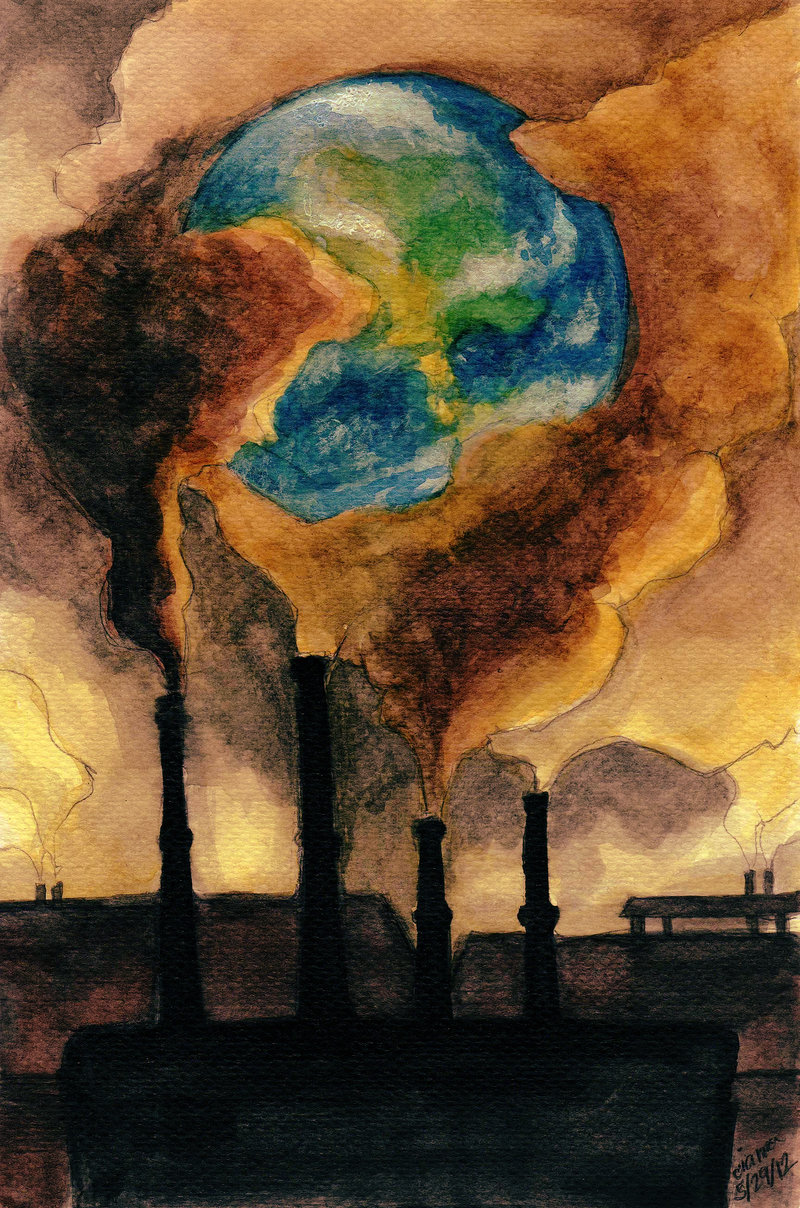
(Illustration found here).
The Russians have been feeling the gosh-awful blowback of one reality aspect in the environment’s “new normal” — great waterless heat.
Watch here a fascinating, though highly-disturbing report by CNN iReporter Percy von Lipinski in Moscow, a three-minute clip aptly described as a walk through a “cauldron of hell.” (and the word, ‘cauldron‘ — A large vessel, such as a kettle or vat, used for boiling; a state or situation of great distress or unrest felt to resemble a boiling kettle or vat).
Percy described the sun as a “barely visible dot of orange trying to light the sky.”
The Russian capitol has been consumed by smoke from more than 560 forest/brush/wood-of-any-type-fires burning across the central belly of the country, end results of a heatwave/drought never before seen there; and for the Muscovites, they’re also dealing with peat bog fires — there’s 39 such horrors right now with 27 of them around Moscow — and temperatures near 104F, something also beyond any alive or dead memories.
Check out a dangerous-looking view from the NASA MODIS satellite of the Russian fires at Climate Central.
And although officials downplayed the peril, those fires are also threatening nuclear contamination from the Chernobyl disaster found in forests throughout certain areas of Russia, Ukraine and Belarus.
According to AFP, Philippe Renaud, head of the environmental radiation laboratory at France’s IRSN nuclear safety institute, said “If these trees burn, the cesium would be released into the air where they could be breathed in by people and with the wind even end up in France,” and then reportedly muttered some all-time famous last words: “This isn’t dangerous at all.”
Global climate mutation at work.
According to Dr. Jeff Masters, the Moscow mess is a combo of weather events, creating one of those heinous positive feedback loops: “As a result, soil moisture in some portions of European Russia has dropped to levels one would expect only once every 500 years.”
And from the soil comes food.
The current inferno has already destroyed 20 percent of Russia’s wheat crop, causing Prime Minister Vladimir Putin to ban all grain exports for the rest of the year, a good, judicious move for Russkies, but shit for the rest of the world.
Weather-induced shortages in the international grain market had already driven the price of wheat up by more than 80 percent since early June, but Russia, fourth-largest grain exporter, in its move immediately forced another eight percent jump.
Gwynne Dyer, the historian/journalist, notes the Russian wheat ban won’t raise much alarm to most of the world this particular time, but the event does reveal an early glimpse of climate change impact:
This means that food prices will also rise, but that is a minor nuisance for most consumers in the developed countries, since they spend only about 10 percent of their income on food.
In poor countries, where people spend up to half their income on food, the higher prices will mean that the poorest of the poor cannot afford to feed their children properly.
As a result, some will die — probably a hundred or a thousand times as many as the 30-odd Russians who have been killed by the flames and the smoke.
But they will die quietly, one by one, in under-reported parts of the world, so nobody will notice.
Not this time.
But when food exports are severely reduced or banned by several major producers at once and the international grain market freezes up, everybody will notice.
…
The world grain reserve, which was 150 days of eating for everybody on the planet 10 years ago, has fallen to little more than a third of that.
(The “world grain reserve” is not a mountain of grain somewhere, but the sum of all the grain from previous harvests that is still stored in various places just before the next big Northern Hemisphere harvest comes in.)
We now have a smaller grain reserve globally than a prudent civilization in Mesopotamia or Egypt would have aimed for 3,000 years ago.
Demand is growing not just because there are more people, but because there are more people rich enough to put more meat into their diet. So things are very tight even before climate change hits hard.
The second problem is, of course, global warming.
The rule of thumb is that with every one-degree C rise in average global temperature, we lose 10 percent of global food production.
In some places, the crops will be damaged by drought; in others by much hotter temperatures.
Or, as in Russia’s case today, by both.
And then again, maybe not-so-early a glimpse: As one can see, the Russkies ain’t alone in the wide, wide world.

(Illustration found here).
Summer in the US this year isn’t exactly another from Russia with hot-love, but records have been snapped across the eastern/southern part of the country as peoples sweated, sweltered and then stank in a heat wave where there’s no real relief.
Last month, evening TV newscasts seemingly always led with clips depicting all kinds of different peoples in big eastern US cities, playing in hydrants, wiping brows, boiling — followed by shots of the BP disaster, of course — and after some weather-related details, gushered forth with tons of human-interest stories, which got real-old, real-quick.
Read some stats on broken temp records across the US at CapitalClimate, and note the personal insert by the writer: “It’s still 90° in Washington at 7 pm.”
After a weekend of somewhat a respite from the heat, temperatures across the south are expected back to the brutal level by this week.
Here on California’s north coast, this has been a very-cool, and very-sun-less summer — ain’t weather odd.
Via Google Earth, it appears that directly straight-east (2,286 miles and nearly five hours by air) from Moscow is Islamabad, Pakistan, the capital of a country awash literally in a direct-opposite disaster — heavy rains and massive flooding on an unprecedented scale, even where bad shit happens apparently all the time.
Via CNN: “Pakistan has been hit by the worst flood of its history,” Prime Minister Yousuf Raza Gilani said in a televised speech Friday. “As I speak, the flood is still engulfing new areas and adding to the scale of devastation.”
The regional to national disaster has killed 1,600 and more heavy rain is currently falling, creating bad-case scenarios for millions of people — waters have reached the tip of the “food basket of Pakistan” 1.4 million acres of agricultural land has already been flooded.
(Illustration found here).
And east of acid-smoked Moscow there’s plenty of water.
Massive rain created flashing flooding the last few days in Poland, Germany and the Czech Republic, killing at least 15 people: A Polish firefighter said the scene in Bogatynia, in southwestern Poland, was “apocalyptic.” Much of the town of 20,000 was flooded when the Miedzianka River crested, killing one victim, he said.
The damage done already will be counted in millions and millions of dollars, and although rains eased over the weekend, peoples will be digging out for weeks — worse flooding in a hundreds of years.
Meanwhile, back on Red Square, Alexander Frolov, head of the Russian Meteorological Center, waxed dramatic on Monday:
“We have an ‘archive’ of abnormal weather situations stretching over a thousand years.
It is possible to say there was nothing similar to this on the territory of Russia during the last one thousand years in regard to the heat.”
Dramatic, indeed.
Climate change is most-likely the big one, the ultimate game changer, and from all the indicators already here and might be a-coming faster than originally anticipated – sequence of “the actual trajectory” of global warming is quicker, faster.
A perfect storm of mad, dangerous shit, going off at linked hyper-irregular intervals — what science people call “extreme weather events.”
Jean-Pascal van Ypersele, a vice president of the UN’s IPCC, on these remarkable occurrences and how these disasters are consistent with what’s happening with mankind-caused climate change: “These are events which reproduce and intensify in a climate disturbed by greenhouse gas pollution,” he said. “Extreme events are one of the ways in which climatic changes become dramatically visible.”
And it’s going to get worse and worse, quicker and quicker.
What’s a body to do?
Actually fly away.
One of the earth’s supposedly great brainiacs, astrophysicist Stephen Hawking, says if humanity hopes to survive we must leave the earth or face extinction: “It will be difficult enough to avoid disaster in the next hundred years, let alone the next thousand or million,” Hawking said. “Our only chance of long-term survival is not to remain inward-looking on planet Earth, but to spread out into space.”
Not until it stops raining.
Weather as Climate
Filed Under Cloud gazing, Environment, Weather | 1 Comment
New book out Tuesday on weather and climate change.
Heidi Cullen, The Weather Channel‘s on-air climate specialist, is the author of The Weather of the Future: Heat Waves, Extreme Storms, and Other Scenes from a Climate-Changed Planet, in which local conditions are the up-close and personal of what is occurring with the planet.
AP has a review/look-see.
Money quote:
“Most Americans believe that we will not take steps to fix climate change until after it has begun to harm us personally,” she writes.
“Unfortunately, by that point it will be too late. The climate system has time lags. … So, by the time you see it in the weather on a daily basis, it’s too late to fix …”
Yes…as right now the Russians, the Chinese, the Pakistanis, along with other peoples in other parts of the globe are experiencing first-hand, a hands-on primer for climate change.
(h/t: theoildrum)
Read an asshole version/review of Cullen’s book here and see a good example of why the good, green earth and all its peoples are screwed.
Earth Under the Weather
Filed Under Cloud gazing, Environment, Scratching Sounds, Weather | 2 Comments
As this summer carves its way through the year, any dumb-ass can see something fishy is going on with the planet’s weather systems, like an old, old radiator busting its seams — heat and more heat.
Global warming might be beyond the “tipping point.”

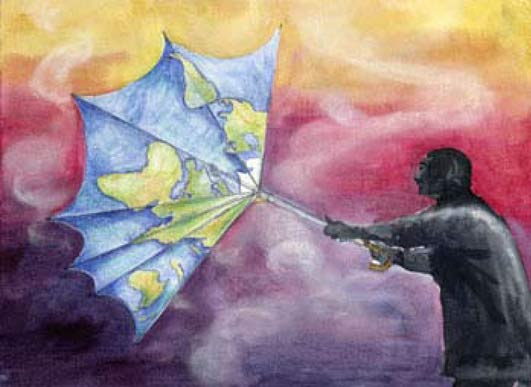
(Illustration found here).
Climate change has always been a serious subject here at Compatible Creatures, a topic seemingly even more horrifying, and scarer, than even stuff like war, the Great Depression, rectal cancer, or John McCain, and carrying with it this unfurling scenario which now can be readily seen by anyone with any kind of walking-around sense — unless you’re in the ilk of Jim Inhofe or any of his kin.
Just in the last three years, from all indications, the environment in which humanity dwells appears to be accelerating much-quicker than anticipated toward some type of near-unlivable condition as witnessed this past week with a report, titled “State of the Climate 2009,” from US National Oceanic and Atmospheric Administration: “When we follow decade-to-decade trends using multiple data sets and independent analyses from around the world, we see clear and unmistakable signs of a warming world,” says Peter Stott, a climate scientists with the UK’s Hadley Centre for Climate Prediction and Research.
Less than a year ago, The Climate Change Science Compendium 2009 reported blowbacks within climate change were moving faster, and quicker than anticipated:
In addition, increased absorption of the main greenhouse gas carbon dioxide by oceans is leading to acidification of seawater faster than expected.
For example, water that can corrode a seashell-making substance is “already welling up along the California coast — decades earlier than existing models predict,” the report said.
Climate change is not THE can to kick further down the road for future generations to deal with, like oil, for instance, which apparently will keep the planet machined-in up for a little while longer, or maybe peak oil is another worm in the apple in the eye of mankind — President Obama was in Detroit on Friday to relish in the financial uptick of US auto makers, never mind the coming years; instead of bailing out the car makers last year, Obama should have started the process to “phase” them out, but that’s too much to ask, huh?
Well, the assholes in the US Congress couldn’t get a climate bill passed this year, despite everything.
The problem, though, was priority — it was either health care or climate change.
And one must remember this about climate change: The situation will soon become horrifyingly and depressingly mega-obvious.
Two years ago in Copenhagen, Denmark:
Recent observations confirm that, given high rates of observed emissions, the worst-case IPCC scenario trajectories (or even worse) are being realised.
For many key parameters, the climate system is already moving beyond the patterns of natural variability within which our society and economy have developed and thrived.
These parameters include global mean surface temperature, sea-level rise, ocean and ice sheet dynamics, ocean acidification, and extreme climatic events.
There is a significant risk that many of the trends will accelerate, leading to an increasing risk of abrupt or irreversible climatic shifts.
Now, financial and health care reform are indeed needed, but next to climate change, neither can hold a waxing candle.
Out Drankin’
Filed Under Cloud gazing, Musings | 1 Comment
As the economy tanks, people seem to be drinking their financial problems away, as research indicates more US peoples are hitting the bottle, with more white guys getting bombed than any other ethnic group.
Free, white and drunk:
Whites are more likely than blacks and Hispanics to get drunk. Twenty percent of white men drank to intoxication at least once a month, compared with just 13 percent of black men.
In Gallup poll released Friday, 67 percent of US adults claim to down at least one alcoholic beverage on occasion, the highest level in 15 years — and 72 percent of the those aged 18-to-54 appreciated alcohol.
(Illustration found here).
Income also apparently has played a factor in bellying up to the bar.
Gallup’s poll reported 81 percent of people making $75,000 a year enjoyed booze, but only 46 percent of those making less than $20,000 said they drank — no credit.
In order to survive in an employment environment where there’s five people after one job opening, booze, weed and just-plain bad behavior becomes the “new normal” for daily life.
The bubble-bursting of the American Dream alters perception, finances shift and life get’s a bit dicey:
“I’m seeing an increase in bad lifestyle choices,” confirms Jonathan Alpert, a New York psychotherapist and relationship columnist.
“People are staying up until the wee hours of the morning, there’s an increase in smoking, drinking and sexual behaviors like surfing porn and using hookers.”
…
People are also shoplifting more.
According to the Global Retail Theft Barometer study, stealing has risen 6% during the past year. Retailers attribute the increase in five-fingered discounting to the soured economy because of the items being pocketed–fresh meat, for instance, is a particular favorite.
As someone involved in retail liquor sales, it’s the economy, dumb-ass, and drink up!
Friends
Filed Under Cloud gazing, Musings | Leave a Comment
Lack of friendship is supposedly worse on your well being than a Quadruple Bypass Burger from the Heart Attack Grill.
From Reuters on a report released Tuesday by a research team at Brigham Young University:
Having good social relationships — friends, marriage or children — may be every bit as important to a healthy lifespan as quitting smoking, losing weight or taking certain medications…
…
“A lack of social relationships was equivalent to smoking up to 15 cigarettes a day,” psychologist Julianne Holt-Lunstad, who led the study, said in a telephone interview.
Her team conducted a meta-analysis of studies that examine social relationships and their effects on health. They looked at 148 studies that covered more than 308,000 people for their analysis, published in the Public Library of Science journal PLoS Medicine at http://www.plosmedicine.org.
…
Having low levels of social interaction was equivalent to being an alcoholic, was more harmful than not exercising and was twice as harmful as obesity.
Social relationships had a bigger impact on premature death than getting an adult vaccine to prevent pneumonia, than taking drugs for high blood pressure and far more important than exposure to air pollution, they found.
Yet, the techno-irony:
Her team found some troubling evidence that Americans are becoming more isolated, and thus losing the support and care that love and friendship provide.
“For instance, trends reveal reduced intergenerational living, greater social mobility, delayed marriage, dual-career families, increased single-residence households, and increased age-related disabilities,” they wrote.
“More specifically, over the last two decades there has been a three-fold increase in the number of Americans who report having no confidant,” they added.
“Such findings suggest that despite increases in technology and globalization that would presumably foster social connections, people are becoming increasingly more socially isolated.”
Modern life seems in itself, a “feedback loop,” which creates or makes an environment or a situation far-even worse, as there’s more communication but far less friendship.
So, if you always dine alone on a menu of burgers and fries, you’re one screwed puppy.
‘Why aren’t they turning?’
Filed Under Cloud gazing | Leave a Comment
In the midst of bad news from many quarters, this latest does make one feel better.
From Wired:
That asteroid is Apophis, a 900-foot asteroid. Calculations released on Christmas Eve 2004 appeared to show that there was a greater than 2 percent chance the asteroid would hit the Earth in 2029.
The asteroid appeared ready to give the Earth its closest shave since astronomers began looking for such things.
It was judged a 4 on the Torino Impact Hazard Scale for a short time, the highest rating any near-Earth object has received.
…
Even though the asteroid doesn’t look like it’s going to hit Earth, on April 13, 2029, it will come closer to Earth than any other near-Earth object that we know of.
It will pass just 18,300 miles above the planet’s surface.
A comfort, though slight, is the notion the event isn’t loosely-scheduled for another near-30 years.
And with a real-huge shitload of nefarious situations currently facing the planet, to paraphrase George Carlin’s “Hippy Dippy Weatherman,” don’t sweat that piece of space rock coming our way.
(Illustration found here).
Light-Up a Smoke
Filed Under Cloud gazing | Leave a Comment
Copenhagen: Tempers flared Monday at the United Nations climate summit as poor nations staged a walkout to protest what they called inadequate aid offers from rich countries, and the U.S. and China jockeyed for position.
The talks have become what one observer called a “farce,” as guidelines agreed on two years ago are not even obtainable because these clowns can’t even agree now on the basics — and it’s still about the money.
Developed countries vs those undeveloped — the rich are stalling the not-so-rich: “The disaster has already begun because we have not closed the gap an inch. We have not moved,” a senior Asian negotiator said. “We are just trying to paste over it with political rhetoric.”
(Illustration found here).
While delegates to the conference are playing grab-ass with a planet’s future, the need for some kind of killer agreement to curb/stop greenhouse gases or the days ahead will be a killer time.
Sadly, and mighty depressing is the actual reality — what needs to be done in time to stop/mitigate the horror coming just near-literally around the corner.
Environmental activist Bill McKibben posted a sobering view today at environment360 on the challenge of what’s at stake.
Some snippets:
But here’s the thing: The words don’t count.
None of them. If you want to understand what’s going on here, you need to shut out the words, the drama, the craziness, and just focus on numbers — and really just a few.
Outside the window, right now, the atmosphere contains 390 parts per million (ppm) of CO2.
That’s too much — as a result, sea ice is melting, glaciers retreating, deserts spreading.
Science has told us where we need to go: 350 ppm.
There’s really not much pushback against that number — the UN’s chief climate scientist Rajendra Pachauri has made it clear that it’s a necessary target.
…
So here’s the number at the moment.
Take every plan — the meager American one, the more aggressive European targets, the Chinese promises to use less carbon per yuan of output, the Brazilian pledges about forests, the Maldives hope of going carbon neutral inside a decade. Push the button.
In the year 2100, the atmosphere will contain 770 parts per million CO2.
And even with all this serious science shit, there are still some real-mean-ass, dumb-ass people, like a for instance, Sen. Jim Inhofe, a delusional-type A character who will reportedly travel to Copenhagen to show his US ass-ignorance, even demanding an investigation into “climate-gate” as global warming is a massive, way-complicated fraud: “They’re cooking the science,” Inhofe said. “The same things that came out on these e-mails is what I said four years ago.”
And to this comes a snap-back from US Sen. Barbara Boxer, chair of the Environment and Public Works Committee: “Well, my good friend Sen. Inhofe is entitled to his opinion, but he’s not entitled to his own facts.”
Words not numbers — a match waiting…
Anoxic Anxiety
Filed Under Cloud gazing, Scratching Sounds | Leave a Comment
Nearly in a near-panic.
Wikipedia: Oceanic anoxic events or anoxic events occur when the Earth’s oceans become completely depleted of oxygen (O2) below the surface levels.
Although anoxic events have not happened for millions of years, the geological record shows that they happened many times in the past.
Anoxic events may have caused mass extinctions.
These mass extinctions were so characteristic they include some of those which geobiologists employ to serve as a time marker in biostratigraphic dating.
It is believed oceanic anoxic events are strongly linked to lapses in key oceanic current circulations, to climate warming and greenhouse gases.

(Illustration: ‘Manatee In The Sea Grass‘ by Joann Shular found here).
Meanwhile, in Copenhagen: The Associated Press reports that the protests — which attracted 40,000 to 100,000 people, depending on the source — were “mostly peaceful.”
Peoples from 194 nations are meeting under the UN’s Framework Convention on Climate Change and despite all the hub-bub outside on the streets, early reports indicate not much has been accomplished other than the rich are still being assholes.
Also reportedly this week the climate talks will become dramatic as more activists and a shitload of world leaders (President Obama is scheduled for Friday — closing day), US congress-people, journalists and all kinds of other types will be trying to take up space at the conference.
And drama kicked-off today — climate science is serious as a heart-attack.
From DeSmogBlog:
During a live primetime climate-debate broadcasted on Danish national TV one of the participators, climate-skeptic scientist Henrik Svensmark, had a heart attack.
Bjorn Lomborg was by his side in the tv-studio when the scientist mid-sentence fell ill.
THe 41 year old Henrik Svensmark made an awkward spasm/shudder and burst out a strange noise, sounding like a cough.
The other participants in the debate looked baffled and he mumbled:
“It’s my heart,” and fell to the ground and the pacemaker kicked in once more and you could hear him scream. Bjrøn Lomborg yelled “call an ambulance, call an ambulance” and the host and the other participants came over to help the man.
Svensmark is supposedly one of the “sunspots and cosmic rays, not humans, cause global warming” kind of guys — a point reportedly refuted by the science.
And along with global warming, the “evil twin of climate change” – ocean acidification — is apparently getting worse as a report released to the conference implied, although the CO2-related phenomenon doesn’t get much press.
The study from the International Union for Conservation of Nature (IUCN) paints another bleak picture for the earth’s environment.
From the UK’s The Guardian on the report:
Ocean acidification — the facts says that acidity in the seas has increased 30% since the start of the industrial revolution.
Many of the effects of this acidification are already irreversible and are expected to accelerate, according to the scientists.
…
Although oceans have acidified naturally in the past, the current rate of acidification is so fast that it is becoming extremely difficult for species and habitats to adapt.
“We’re counting it in decades, and that’s the real take-home message,” said Dr John Baxter a senior scientist with Scottish Natural Heritage, and the report’s co-author. “This is happening fast.”
The report, published by the EU-funded European Project on Ocean Acidification, a consortium of 27 research institutes and environment agencies, states that the survival of a number of marine species is affected or threatened, in ways not recognised and understood until now.
And also from the UK and today’s timesonline:
Ocean acidification has been quite scandalously left out of the reckoning in the past few weeks.
I am not for a moment belittling the science behind man-made global warming. This still seems to me solid, despite the shenanigans at the University of East Anglia (“climategate”).
That levels of carbon dioxide in the atmosphere are rising is not disputed. We have known since the 19th century that carbon dioxide was a crucial greenhouse gas. Venus has a lot of it and is hot as hell. Mars has almost none and is cold as ice.
…
Since the beginning of the industrial revolution in about 1750, sea water acidity has increased by 30%.
The speed and degree of this change are faster than anything that had happened for 55m years.
The changes being observed are beginning to disrupt the ability of any organism to make shells out of calcium carbonate.
Organisms that do this include corals, crabs, lobsters, small creatures vital to the diet of fish and plankton of the kind that die and form chalk deposits such as the white cliffs of Dover.
Projections show that by 2060, given the current rate of fossil-fuel emissions, sea water acidity could have increased by 120%.
…
Such an effect could trigger a chain of reactions through entire ecosystems, from whales to fish and shellfish, with huge implications for economies and wildlife.
It could even stop the sea absorbing as much carbon dioxide as it does now, accelerating global warming.
It is pretty scary stuff.
Yes.
In a hearing Dec. 2, Dr. Jane Lubchenco, administrator of the US National Oceanic and Atmospheric Administration (NOAA), testified before the Senate Select Committee on Energy Independence and Global Warming about seawater acidity and it’s consequences, which is also pretty scary stuff.
Read a comprehensive look at the current state of ocean acidification here.
Time to do something appears to have been yesterday.
Quick Punch
Filed Under Cloud gazing | Leave a Comment

(Illustration found here).
A new satellite-based study published Sunday in Nature Geoscience indicates the supposedly more-stable East Antarctic ice sheet has as been losing 57 billion tons of ice bulk a year since 2006.
From the BBC on the report:
“We felt surprised to see this change in East Antarctica,” study leader Jianli Chen from the Centre for Space Research at the University of Texas in Austin told BBC News.
The loss still looks small by contrast with West Antarctica, which is losing 132Gt (tons) per year, and with Greenland, where a recent analysis combining Grace data with other measurements indicated an annual figure of 273Gt.
(h/t Climate Progress).
Another brick in the wall of weird.
Also published Sunday in the Energy Bulletin:
The trouble with apocalypse is that most people have already seen it at the movie theater, watched it on television, read it in a book, or heard all about it from the pulpit.
So inundated with the language of crisis are we that we have become immune to it.
From the perspective of the historian our age has been chock full of “great transformations.”
And, it is, after all, the historian’s business to write about great change even if he or she has to invent some.
…
What apocalyptic narratives do is elevate the importance of the trajectory of every person’s life regardless of his or her station in society.
If we’re all in this together, then we can share in a great destiny no matter who we are.
But destiny sounds like fate.
What can one do if one is headed toward a great apocalypse? Pray, perhaps. Repent, maybe.
But responding to such a gargantuan event calls more for attaining the right relationship with one’s god than engaging in constructive social and political action.
Punch line: Don’t mothball the tuxedo!